

Pricing Guide for Solicitors — What You’ll Actually Pay and Why
The price difference comes down to one question most firms never ask: is this website being built to look good, or to generate enquiries?
A site built on EnquiryOS™ — with the right message, a clear decision path, and a follow-up system behind it — performs differently from a brochure site at any price point. This guide helps you understand what you are actually paying for at each level.
In this guide, we’ll break down exactly what drives the cost of a law firm website in the UK, what you should expect at different price points, and when a lower-cost option might actually be enough.
By the end, you’ll understand:
- The typical price range for solicitor website design in the UK
- What affects cost, what does not, and where hidden costs appear
- How to weigh cost against ROI
- Clear answers to common questions like timelines, ownership, and value
Where Krystal Designs typically sits
At Krystal Designs, most of our law firm website projects sit in the strategic conversion website or growth system range.
Our Web Growth Design starts from £3,500 + VAT. For firms that want a fuller growth system from day one, projects typically sit between £5,000 and £10,000 depending on scope.
We are not usually the cheapest option, and we are not trying to be. Our work is designed for law firms that want their website to generate qualified enquiries, not just look professional online.
That means our projects usually include strategy, messaging, conversion-focused design, professional copywriting, SEO foundations, enquiry capture, analytics, and launch support.
For firms that want ongoing growth, this can expand into a fuller marketing system with practice area content, lead magnets, CRM follow-up, automation, local SEO, reporting, and optimisation.
If you only need a simple website for referrals, a lower-cost brochure site may be enough. But if your website needs to help generate regular enquiries for areas such as family law, immigration, conveyancing, employment law, wills and probate, or commercial law, you should expect to invest in the middle or upper ranges explained below.
The Short Answer: Typical Price Range for Law Firm Websites
In the UK, most law firm websites fall into one of three broad ranges:
- Basic brochure website: £1,000–£3,500
- Strategic conversion website: £4,500–£9,500
- Full law firm growth system: £10,000–£25,000+
A lower-cost brochure website may be enough if your firm mainly relies on referrals and simply needs a credible online presence.
A strategic conversion website is usually a better fit if you want your site to explain your services clearly, build trust, rank in search, and generate qualified enquiries.
A full growth system is usually for firms that want the website, SEO, content, lead capture, CRM follow-up, automation, and reporting working together.
The real question is not simply “How much does a law firm website cost?” It is “What does the website need to do for the firm?”
Where your law firm website investment usually goes
When you invest in a law firm website, you are not just paying for design. The investment is usually spread across the strategy, content, design, build, SEO, trust signals, and enquiry systems needed to turn the website into a useful business asset.
| Area | What it covers |
|---|---|
| Strategy | Positioning, ideal client journey, practice area structure, enquiry goals |
| Copywriting | Homepage copy, practice area pages, FAQs, solicitor profiles, calls to action |
| Design | User experience, mobile layouts, trust signals, accessibility, page flow |
| Development | Website build, forms, speed, technical setup, testing, integrations |
| SEO | Keyword research, local SEO, metadata, redirects, site structure, schema |
| Compliance and trust | GDPR, privacy, SRA-related trust signals, reviews, accreditations, testimonials |
| Conversion | Enquiry forms, consultation booking, phone CTAs, lead capture, live chat |
| Launch | Analytics, tracking, checks, handover, training, post-launch support |
A cheaper website usually reduces or removes some of these areas. That may be fine if you only need a simple online presence. But if the goal is to generate better enquiries, these are the parts that make the website perform.
What You’re Really Paying For
A law firm website should do more than look polished. It should help a potential client understand their problem, trust your firm, choose the right next step, and feel confident enough to enquire.
Here are the elements that typically affect cost:
- Web strategy and positioning – alignment with your ideal clients and market positioning
- Conversion-focused design – layouts that encourage enquiries, not just visits
- Professional copywriting – messaging written for clarity, persuasion, and SEO
- SEO, compliance and trust – mobile-friendly build, fast loading, GDPR-conscious forms, accessibility best practices, and SRA-related trust signals
- Lead capture tools – enquiry forms, booking flows, live chat or chatbots
- Follow-up systems – optional CRM and automation to nurture leads over time
Without these, a website often functions more like a static brochure than a growth engine.
What Affects the Final Cost
Here’s a breakdown of the factors that can move your price up or down:
| Factor | Why It Matters | Cost Impact |
| Number of Pages | More service areas = more design, content, and development | Higher |
| Custom Integrations | Portals, calculators, or client tools | Higher |
| Lead Magnets | Strategic downloads/guides to capture enquiries | Higher |
| Follow-up System | Email nurturing, CRM setup, automation | Higher |
| Traffic Strategy | SEO only vs. SEO + paid ads | Higher if ads included |
What can bring the cost down?
The cost of a law firm website is usually lower when the project is simpler, clearer, and has fewer moving parts.
Costs may come down if:
- Your services, audience, and positioning are already clear
- You already have usable copy, solicitor profiles, testimonials, reviews, and case studies
- You only need a small number of core pages
- You do not need many individual practice area pages
- You do not need advanced SEO at launch
- You do not need CRM, booking, payment, live chat, or automation integrations
- You are happy to use a simpler design structure
- You want to phase the work over time instead of building everything at once
For example, a small referral-led firm with three main services will usually need a smaller project than a multi-office law firm with several practice areas, multiple solicitor profiles, local SEO goals, and a need for regular online enquiries.
The key is not to cut corners that affect trust or enquiry quality. The best way to reduce cost is to simplify the scope while protecting the parts that help potential clients choose and contact you.
Things that generally don’t have much impact on cost:
- Logo placement tweaks
- Colour schemes or fonts
- Using a well-structured template vs. a custom framework (if the strategy is solid)
Common law firm website packages
Law firm websites usually fall into three common investment levels. The right option depends on whether your website simply needs to support referrals, generate more enquiries, or become part of a wider growth system.
Here’s a quick comparison:
| Package | Suitable for | What’s included | Typical investment | Not right for |
|---|---|---|---|---|
| Starter Law Firm Website | New, small, or referral-led firms | Branded template, 5–8 pages, basic enquiry forms, solicitor profiles, light SEO, client-supplied content | £1,500–£4,000 | Firms that need consistent online enquiries, competitive SEO, or strong conversion strategy |
| Conversion-Ready Law Firm Website | Established firms wanting better enquiries | Strategy, conversion design, professional copywriting, practice area pages, reviews/case studies, local SEO, enquiry routing, analytics, launch checklist | £4,500–£9,500 | Firms that only want a cheap brochure site or are unwilling to invest in copy, proof, and positioning |
| Law Firm Growth System | Growth-focused firms or multi-practice firms | Everything above plus lead magnets, landing pages, blog/resource setup, schema, advanced tracking, CRM integration, automation, nurture sequences, retargeting campaigns | £10,000–£25,000+ | Firms that are not ready for ongoing marketing, follow-up, reporting, or optimisation |
Tip: If budget is tight, fix conversion first so more existing visitors enquire. Then improve SEO. Then scale with content, ads, automation, and follow-up.
Does pricing change by type of law firm?
Yes. A small Wills and Probate firm with a few core pages is very different from a multi-location law firm offering family law, immigration, conveyancing, employment law, commercial law, and litigation.
The more practice areas, locations, trust signals, enquiry pathways, content, and integrations required, the more the project usually costs.
| Law firm type | Typical complexity | Why pricing may vary |
|---|---|---|
| Sole practitioner | Low to medium | Fewer pages, simpler structure, lighter SEO |
| Referral-led local firm | Low to medium | Needs credibility and trust, but may not need heavy SEO |
| Family law firm | Medium to high | Sensitive buyer journey, trust, FAQs, reviews, consultation pathways |
| Immigration law firm | Medium to high | Competitive SEO, urgent enquiries, detailed service pages, multilingual considerations |
| Conveyancing firm | Medium | High-volume enquiries, quote forms, local SEO, process clarity |
| Multi-practice firm | High | Multiple service areas, solicitor profiles, case studies, SEO architecture |
| Multi-office firm | High | Location pages, local SEO, office-specific trust signals, enquiry routing |
One-off vs ongoing costs
Most law firm website projects include a one-off build cost. However, there may also be ongoing costs depending on how much support, marketing, and maintenance you need.
| Item | Typical ongoing cost |
|---|---|
| Hosting | £10–£50/month |
| Website care plan | £79–£249/month |
| Licences and plugins | £0–£50/month |
| SEO/content support | £600–£2,500+/month |
| Google Ads management if needed: | £500–£2,000+/month + ad spend |
| CRM/email tools | Varies by system |
| Live chat or chatbot tools | Varies by provider |
Tip: SSL certificates should usually be free through providers such as Let’s Encrypt. Be cautious if you are charged heavily for basic HTTPS.
Can the investment be phased?
Yes. Not every law firm needs to build everything at once.
A common phased approach is:
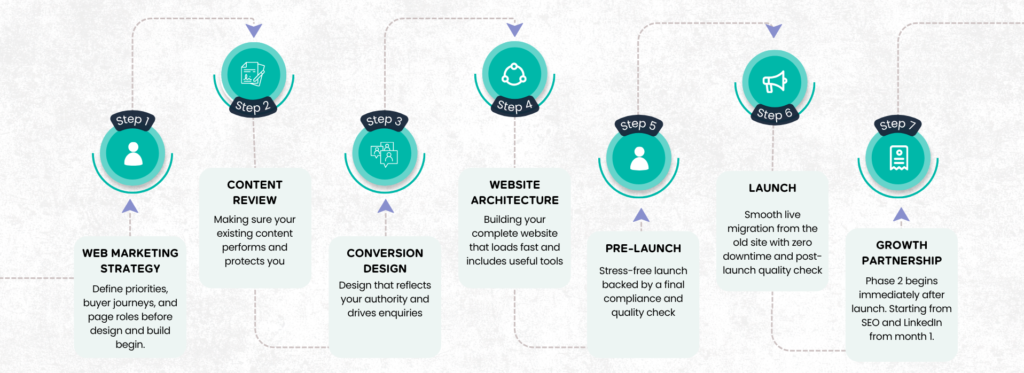
Phase 1: Strategy, messaging, core website, practice area pages, enquiry pathways, and analytics
Phase 2: SEO content, FAQs, case studies, lead magnets, and conversion improvements
Phase 3: CRM integration, automation, nurture sequences, ads, reporting, and ongoing optimisation
This approach can make the investment easier to manage while still building toward a proper client-generation system.
Some firms prefer a one-off website project. Others prefer a smaller initial build followed by monthly growth support. The right structure depends on your budget, goals, and how quickly you want the website to contribute to new enquiries.
Why are some law firm website companies cheap, while others are expensive?
Cheaper website companies are not always bad. If your firm only needs a simple online presence, a lower-cost provider may be a perfectly sensible choice.
However, cheaper providers often keep costs low by:
- Using pre-built templates
- Asking you to provide the copy
- Including little or no strategy
- Offering only basic SEO
- Skipping conversion planning
- Avoiding CRM, booking, live chat, or automation integrations
- Providing limited support after launch
- Relying heavily on AI-generated layouts or copy
- Tying you into their own platform, hosting, or system
That last point is important. Some providers offer a low upfront price, but the trade-off is lock-in. Your site may be built on a closed platform, hosted only with them, or structured in a way that makes it difficult to move elsewhere. If you ever want to leave, rebuild, change provider, or take full control of your website, you may discover you do not own as much as you thought.
More expensive providers usually cost more because they are not just building pages. They are helping you build a client-generation system. That may include strategy, messaging, copywriting, local SEO, practice area structure, conversion design, enquiry capture, analytics, CRM integration, follow-up, and ongoing optimisation.
The right choice depends on what you need the website to do. If it only needs to prove your firm exists, cheaper may be fine. If it needs to generate qualified legal enquiries, the missing pieces in a cheap website can become expensive later.
What about AI-generated law firm websites?
AI website builders have made it easier to get a basic website online quickly. For some firms, this may be enough, especially if you only need a simple digital presence and do not rely on your website for enquiries.
The limitation is that AI-generated websites often rely on generic layouts, generic copy, and surface-level messaging.
For a law firm, that can be a problem. Potential clients need clarity, reassurance, proof, and confidence before they enquire. They want to understand your services, your process, your experience, your reviews, your fees where possible, and what will happen next.
AI can be useful during the website process. It can help with research, drafts, structure, and ideas. But it should not replace legal-sector positioning, buyer insight, conversion planning, professional copywriting, SEO structure, compliance awareness, or follow-up systems.
In simple terms: AI can help create pages. It does not automatically create a law firm website that builds trust and generates qualified enquiries.
When a conversion-ready law firm website may not be worth it
A £4,500–£9,500+ law firm website may not be the right investment for every firm.
It may not be worth it if:
- You already get all the work you need from referrals
- You do not want or need online enquiries
- You only need somewhere for people to check your firm is legitimate
- You are not ready to follow up with enquiries properly
- Your services or positioning are still unclear
- You mainly want a prettier version of your current website
- You are not prepared to provide input, feedback, proof, reviews, or expertise during the project
In these situations, a simpler starter website may be the better financial decision.
But if your current website is not explaining your value clearly, not converting enough visitors, not supporting your enquiry process, or not helping you attract the right matters, then a more strategic website is usually the better investment.
Cost vs ROI: The Real Question
The more important question than “How much does a law firm website cost?” is: “What’s the cost of doing nothing?”
The ROI of a law firm website depends heavily on matter value.
For example, if one new client is worth £1,500 in profit, then a website that helps generate just a few additional clients can recover its cost quickly.
If your average matter value is higher, such as in family law, immigration, commercial, litigation, or high-value private client work, the payback period may be even shorter.
This is why the cheapest website is not always the lowest-risk option. A cheap site that generates no enquiries can cost more in lost opportunities than a strategic site that pays for itself.
A £3,000 brochure site might look professional but generate no enquiries. That can mean lost opportunities worth tens of thousands annually. A strategic website starting from £3,500 + VAT can pay for itself quickly if it helps secure even a handful of the right clients.
A £7,500–£9,500 investment in a strategic, conversion-focused website can pay for itself quickly if it helps secure even a handful of new clients.
That said, not every firm needs the same level of investment. If your business model relies heavily on referrals, a modest site may serve your needs. If growth through digital marketing is a priority, a more strategic build is usually the better long-term decision.
Fountain Solicitors had a website that looked professional. It generated almost no enquiries. After rebuilding on a clear message, a structured decision path, and a follow-up system, they went from near zero to 60+ enquiries per month. They have since grown from one office to five and from under 10 staff to over 30. That growth did not come from a rebrand or a bigger ad budget. It came from a website that finally did its job.
Hidden costs to watch for
Before choosing a law firm website provider, ask exactly what is included and what is not.
Common hidden costs include copywriting, photography, stock imagery, premium plugins, hosting, website care, SEO migration, redirects, analytics setup, accessibility improvements, cookie compliance, CRM tools, booking tools, live chat, and ongoing content.
Also ask what you own. A low-cost website can become expensive later if you cannot easily move it, export your content, access your data, or change provider.
Conclusion: How much should your law firm spend?
When considering solicitor website design pricing, focus less on the number and more on what you need the website to do.
If referrals drive most of your work and you only need a credible online presence, a starter law firm website may be enough.
If you want to generate more consistent online enquiries, a conversion-ready website is usually the minimum level worth considering.
If growth is the goal, and you want your website, SEO, content, lead capture, follow-up, and reporting working together, then a law firm growth system is usually the better long-term investment.
If you’d like to see how these cost ranges apply to your firm, explore our Pricing Page, where we break down options by firm size and growth goals.
Final Thought
The right website isn’t the cheapest or the most expensive. It’s the one that matches your firm’s ambitions and pays for itself over time.