

You have probably looked at Wix. Maybe you have watched a few Youtube tutorials. The pricing pages say you could have a website live in a weekend for less than £20 a month, and the comparison sites make it look even simpler.
So the question is a fair one: can you just build a website yourself and save money?
The short answer is yes. You can absolutely build your own website. The tools have improved significantly and a technically capable person can put together something that looks credible in a day or two.
But here is the question that matters more: will it generate enquiries?
That is where the answer changes.
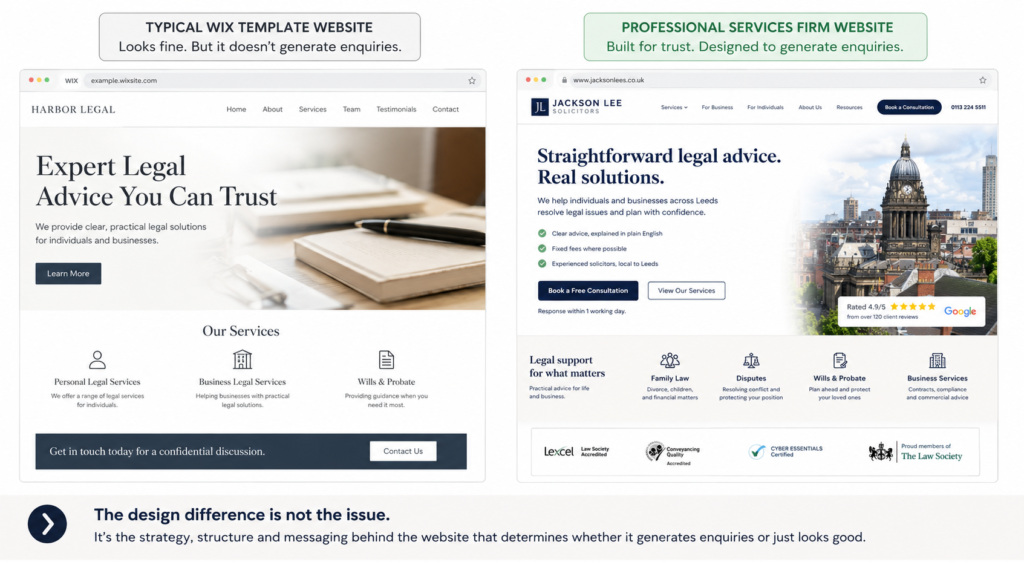
I speak to managing partners and directors at UK law firms and professional services firms every week. Most of them have already had a website built. Some paid £4,000 for it. A few paid considerably more. And the vast majority say the same thing: “It looks fine but nobody contacts us through it.”
A DIY website does not fix that problem. A professionally designed website does not necessarily fix it either. The issue is not the tool you used to build it. The issue is what the site is actually doing, or not doing, once a visitor lands on it.
This article gives you an honest breakdown of what building your own website can and cannot do for a professional services firm, what the actual costs are when you account for your time, and what the firms that generate consistent enquiries do differently.
In This Article
- What website builders can actually do in 2026
- The real cost of building your own website
- Why most professional services websites fail to generate enquiries
- Three things your website needs to do that no builder will tell you about
- When DIY makes sense and when it does not
- What to do instead if you want results, not just a website
- FAQs
What Website Builders Can Actually Do in 2026
Wix, Squarespace, GoDaddy Website Builder, and similar platforms have become genuinely capable. The templates are clean. The drag-and-drop editors are intuitive. Mobile responsiveness is built in by default.
If you need a digital brochure, these platforms can produce one. For a small firm that wants a web presence, a contact page, and a list of services, a builder will do that well enough.
The limitations appear when you need more than that.
Custom functionality, such as booking integrations, client portals, or specific form routing, quickly runs into the constraints of what a builder allows. SEO at any serious level requires access to site structure that many builders restrict. Page speed, which directly affects both search rankings and whether visitors stay, varies significantly between platforms and is largely outside your control on a hosted builder.
WordPress, by comparison, gives you full control. That is both its advantage and its challenge. The flexibility that makes it powerful also means it requires more technical knowledge to use well.
The Real Cost of Building Your Own Website
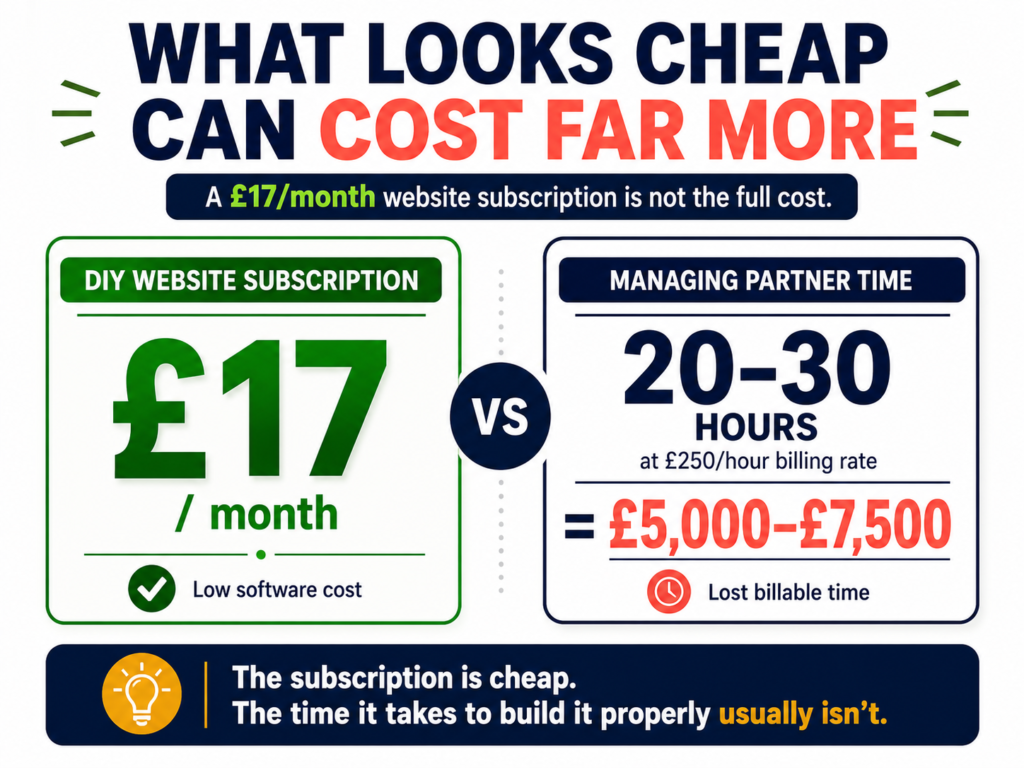
The pricing pages show you £17 to £30 per month for Wix or similar. That is not the cost of building a website.
The cost is your time.
Consider what is actually involved. Choosing a platform. Finding a template. Editing colours, fonts, and layout. Writing the copy. Sourcing or taking photographs. Setting up pages for each service. Adding a contact form. Checking everything works on mobile. Connecting a domain. Looking at it two weeks later and redoing the homepage because something does not look right.
For a managing partner billing at £200 to £400 per hour, a conservative estimate of 20 to 30 hours to build a site properly puts the real cost at £4,000 to £12,000. That is before you account for ongoing time to update it, fix it when something breaks, or improve it when it still does not produce enquiries.
The £17/month figure is real. The total cost is not.
Why Most Professional Services Websites Fail to Generate Enquiries
Here is what appears on almost every professional services website, whether built by a designer or built by the firm partner.
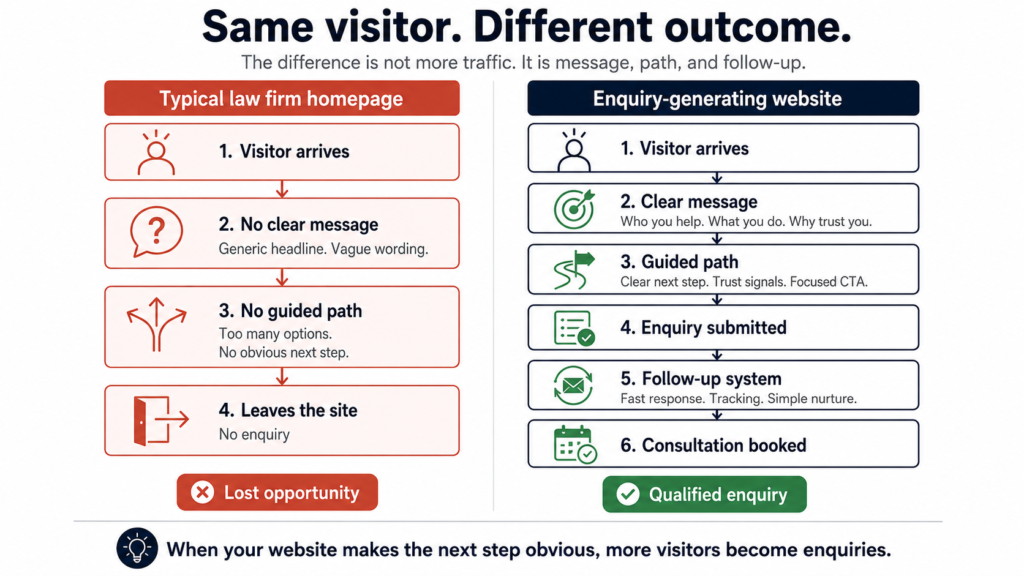
The message is unclear.
A visitor lands on the homepage and reads something like “Expert legal services for businesses and individuals.” That tells them nothing about who you specifically help, what problem you solve, or why your firm rather than the three others in the same postcode. Within a few seconds, they leave.
There is no obvious next step.
The site has a contact page. There might be a phone number in the footer. But there is nothing guiding a visitor from “I found this firm” to “I am going to make an enquiry.” No clear path. No reason to stay. No obvious action to take.
Nothing happens after an enquiry lands.
Someone fills in the contact form on a Monday morning. They hear back on Wednesday. By that point, they have already spoken to a competitor. The enquiry did not convert, and nobody knows why.
These three problems are not issues that any website builder will flag. Wix does not tell you that your homepage copy explains nothing about who you help. GoDaddy does not alert you that a visitor arrived, saw no reason to stay, and left within ten seconds.
The platform does not matter if these three problems remain.
Three Things Your Website Needs to Do
I want to be direct about what separates websites that generate enquiries from websites that do not.
First: it has to be clear, immediately, who you help and why you.
Not in a general sense. Specifically. A managing partner at a West Midlands commercial law firm should read your homepage and think “this is written for me.” That requires more than good design. It requires the right words.
Second: it has to guide visitors toward an action.
Not just have a contact page. Actively guide. That means the right headings, the right structure, the right prompts at the right moments. A site that requires a visitor to work out what to do next will lose most of them before they ever enquire.
Third: there needs to be a process after the enquiry.
A prospective client who fills in your form at 9pm on a Tuesday should receive an acknowledgement immediately and a response within the working day. Most firms do not have this. The firms that do convert at a significantly higher rate.
Fountain Solicitors had a website. Fifteen years ago it was generating zero enquiries. We rebuilt it around these three things. Today they receive over 60 enquiries a month. They have grown from one office to five and now employ more than 30 people. The website was not the magic. The thinking behind it was.
When DIY Makes Sense and When It Does Not
There are situations where a DIY website is the right call.
If you are a very early-stage firm testing whether a service has demand, a quick builder site is appropriate. If you have a tight budget and no current appetite for marketing investment, a basic presence is better than nothing. If you have a team member with genuine digital marketing experience, they may be able to get real results from a builder or a WordPress install.
But for an established professional services firm that wants consistent enquiries, and that has already had at least one website that produced nothing, a DIY approach will almost certainly produce the same result. You will spend time you do not have, produce something that looks fine, and wait for enquiries that do not come.
The thing a builder cannot give you is the thinking. The clarity of message, the structure of the page, the post-enquiry process, the connection between your website and search. That is what makes a website generate enquiries. Tools do not provide it.
What to Do Instead If You Want Results
Before spending time on any website, DIY or otherwise, three questions are worth answering first.
Who specifically are you trying to reach, and what are they searching for when they need what you offer? If you cannot answer this clearly, no platform will fix it.
Does your current homepage make it obvious within five seconds who you help and what to do next? Read it back as if you are a prospective client who has never heard of your firm. If the message is unclear, a new website with the same copy will not help.
What happens when an enquiry comes in? If the answer is “it depends on who picks up the phone”, you are losing clients at the final stage regardless of how much traffic the site receives.
Get these three things right first. Then build, or rebuild, the website around them.
To Summarise
You can build a website yourself and save money on the design cost. That is a real option and for some firms at some stages, it is the right one.
But if the goal is consistent enquiries, the platform is a small part of a bigger question. Most professional services firms that rely on referrals have a window before that pipeline becomes unpredictable. A website that looks credible is not a contingency. A website that generates 20, 30, or 60 enquiries a month is.
The firms that get there do not get there because they chose the right builder or spent the right amount on design. They get there because someone thought carefully about who their clients are, what those clients are searching for, and what needed to happen on the site to turn a visitor into an enquiry.
If your current website is not generating enquiries, the platform is probably not the issue. If you want an honest view on what is actually stopping it, that is exactly what a More Clients Call is for.