Your website is getting visitors and enquiries are coming in, but too few seem to become clients. The difficult part is working out where the gap actually sits.
Most firms answer that question with a guess. They buy more SEO, change the homepage, increase the ad budget or blame the person handling the leads.
Any of those things might help. They might also fix the wrong problem.
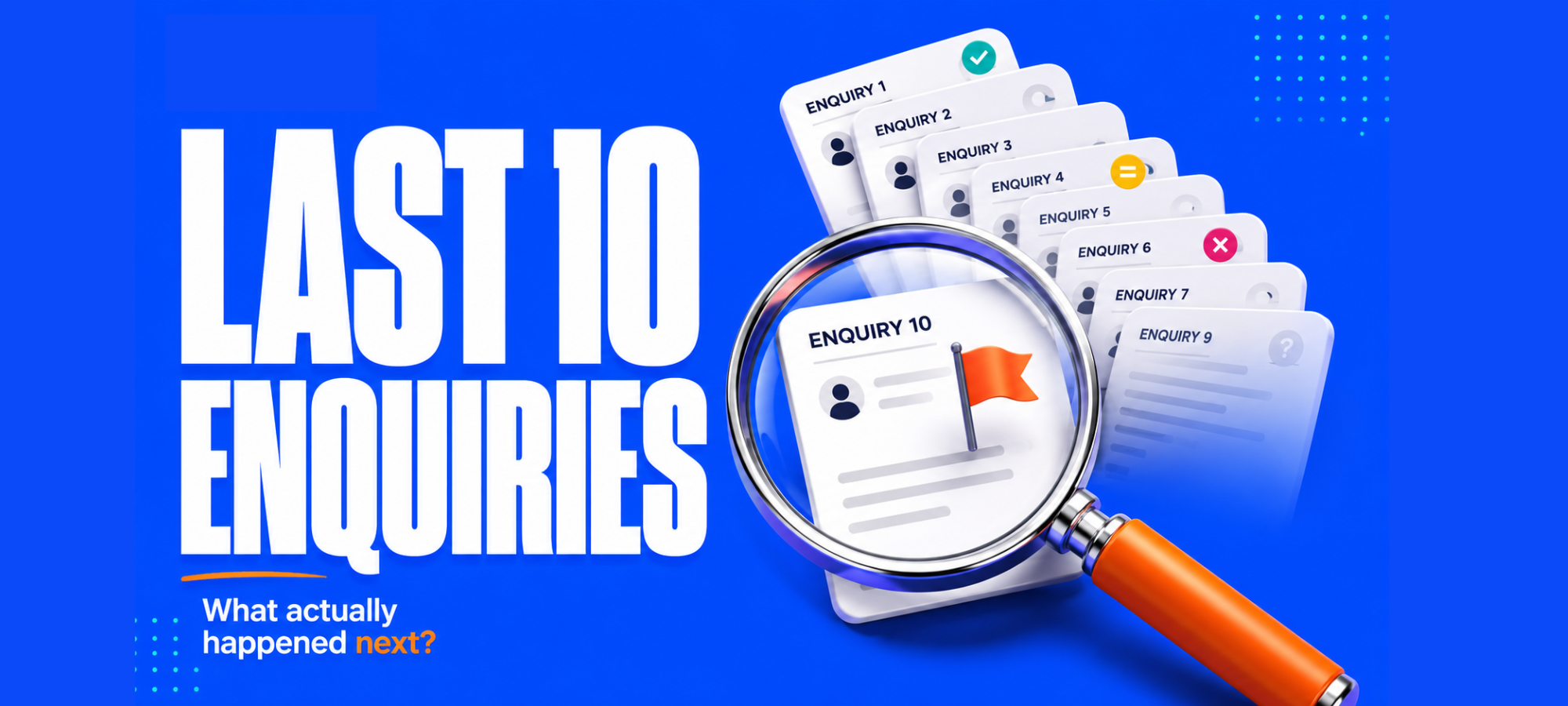
Before you change anything else, look at your last ten genuine enquiries and trace what actually happened to them. Then compare that with how many people were arriving and how many clients were eventually won.
The goal is not to build a perfect report. It is to stop guessing.
Key Takeaways
- Why a form submission is not the same as a successful result
- The three numbers to check before diagnosing the problem
- The five questions to ask about your last ten genuine enquiries
- How to spot whether the gap sits before, during or after the enquiry
- What not to change until you understand the pattern
A Conversion on a Report Is Not the Same as a Client
This is where things often become confusing.
A report can show rising traffic, more clicks and a healthy number of conversions. Meanwhile, the number of actual new clients barely moves.
That happens because different people use the word “conversion” to mean different things. A button click, form submission, phone tap or booked call may all appear as a positive result on a dashboard.
Those numbers can still be useful. The problem starts when nobody follows them through to the commercial outcome.
A form submission is not automatically a genuine enquiry. A genuine enquiry is not automatically a good opportunity, and a good opportunity is not automatically a new client.
If nobody can trace what happened between those points, the reports can look healthy while the business feels stuck.
Why This Is So Hard to Spot
Most firms can see part of the journey.
They can usually see website visits, ad clicks or form submissions. They can also see the clients who eventually sign.
The difficult bit is everything in between.
Which enquiries were genuine?
Which were a good fit?
Who responded?
How quickly?
Which ones turned into real conversations?
Why did the others disappear?
When those answers live across inboxes, call logs, spreadsheets and individual memories, the pattern stays hidden. The firm ends up seeing activity without knowing exactly where the right opportunities are being lost.
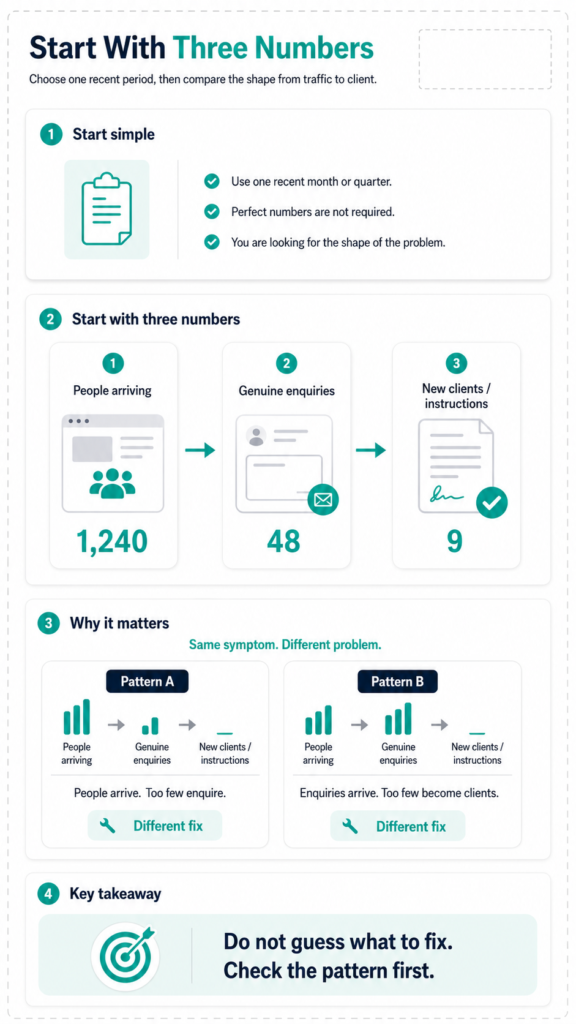
Start With Three Numbers
Before looking at individual enquiries, choose one recent period. A month or a quarter is usually enough.
Find three numbers for that same period:
- people arriving
- genuine enquiries
- new clients or instructions
The numbers do not need to be perfect. You are looking for the shape of the problem.
For example, you might have strong traffic but very few genuine enquiries. You might have plenty of genuine enquiries but very few becoming clients.
Those are two completely different problems. They should not lead to the same fix.
Then Audit Your Last 10 Genuine Enquiries
Pull up your last ten genuine enquiries. Leave out spam, wrong numbers and anyone who was clearly asking for something you do not provide.
For each one, answer five questions.
1. Where Did the Enquiry Come From?
Record the actual source if you know it. That might be a referral, Google search, advert, existing client, social media or something else.
Do not worry if you cannot answer every one. Not knowing is useful because it shows where the current visibility stops.
2. Was It a Good Fit?
Ask whether this was someone you would genuinely want to work with. Do not count every person who filled in a form as equally valuable.
A high number of poor-fit enquiries tells you something different from a low number of good-fit ones. The quality matters as much as the volume.
3. What Happened Next?
Write down exactly what happened after the enquiry arrived. Did someone call, email or send a message?
Record how quickly that happened if you can. The aim is not to judge anyone, but to see the real sequence.
4. Did It Become a Client?
The answer here is simply yes or no. Keep it factual.
If it became a client, note what happened between the first contact and the decision. If it did not, move to the next question.
5. If Not, Do You Know Why?
Be honest.
“They chose someone else” is useful.
“They were not a good fit” is useful.
“They never replied” is useful.
“I’m not sure” is also useful.
The point is to replace assumptions with real examples.
Put Everything in One Place
A spreadsheet is enough.
Use one row for each enquiry and one column for each question. You do not need new software or a complicated CRM project before you start.
The value comes from looking at ten real examples together. Patterns are much harder to see when every enquiry sits in a different inbox or someone’s memory.
What the Pattern Tells You
The same disappointing result can come from very different gaps. This is why choosing the fix before locating the problem usually wastes time and money.
Hardly Any Genuine Enquiries Are Arriving
Look earlier in the journey.
The right people may not be reaching you in the first place. There may be too little visibility, the wrong people may be arriving or the current traffic may not match the services you actually want to grow.
If most of your new work still comes through the same small network, start with How Do You Know When Referrals Are No Longer Enough?
This does not automatically mean you need more traffic. It means the gap appears before enough genuine enquiries exist.
People Are Arriving but Too Few Become Genuine Enquiries
Look at what happens between arrival and contact.
The right person may land on the website but fail to recognise that the firm is relevant to them. They may not understand why they should choose you or may struggle to work out what to do next.
The issue sits before the enquiry arrives. Sending more people through the same experience may increase activity without changing the real result.
Genuine Enquiries Arrive but Too Few Become Clients
Look at what happens after contact.
Good opportunities may be going cold, taking too long to receive a response or disappearing without anyone knowing why. The issue may be in the way enquiries are handled rather than the number arriving.
At this stage, more traffic can make the problem bigger. More enquiries entering the same gap simply creates more lost opportunities.
You Cannot Tell What Happened to Most of Them
That is the finding.
You cannot improve a journey you cannot see. Before changing the website, increasing the budget or replacing the agency, make the path from enquiry to outcome visible.
Why “We Got the Enquiry” Does Not Mean the Job Worked
A website or campaign has not finished its job the moment someone fills in a form.
That person still needs to be genuine. They still need to be a reasonable fit, receive the right response and move towards a real conversation.
This is where dashboard numbers can become misleading.
A report might count ten conversions. The business might remember only four genuine enquiries and win one client.
That does not mean the report is useless. It means the number needs to be connected to what actually happened afterwards.
What Most Businesses Get Wrong
The most common response is to buy more traffic.
If ten enquiries produced two clients, the thinking goes, twenty enquiries should produce four. That only works when the rest of the path is already doing its job.
If good enquiries are going cold after they arrive, more traffic creates more cold enquiries. If the wrong people are filling in the form, more traffic may create more poor-fit leads.
The second mistake is to rebuild the website without checking where the gap sits. A new site may help, but it may also leave the same problem in place with a different design.
The third mistake is to replace a supplier because the numbers feel wrong. Sometimes the supplier is the problem, but sometimes nobody has connected the activity to real outcomes closely enough to know.
What Not to Change Yet
Do not choose the answer before you have looked at the pattern.
You may eventually need more visibility. That does not mean replacing referrals. Should Law Firms Try to Replace Referrals? explains when keeping referrals alone is enough and when another route starts to make sense.
You may need to change what the website says.
You may need to make the next step easier.
You may need to improve what happens after someone gets in touch.
The important thing is that those are different problems. They should lead to different decisions.
Run the Check Before the Next Marketing Meeting
Take your last ten genuine enquiries and write down what actually happened to each one. Then compare those answers with the number of people arriving and the number of clients won.
You are looking for the point where the numbers stop making sense.
That one exercise can change the whole conversation.
Instead of asking:
“Should we spend more on marketing?”
You can ask:
“Where are the right opportunities actually being lost?”
That is a much better question.
The Bottom Line
You cannot fix a problem you have not located. Traffic, the route to enquiry and what happens after contact can all produce the same symptom: too few new clients.
Start with three numbers and your last ten genuine enquiries. Trace what actually happened from arrival to outcome.
Then find the point where the pattern changes.
That is where the next question should start.
Not sure where the gap sits?
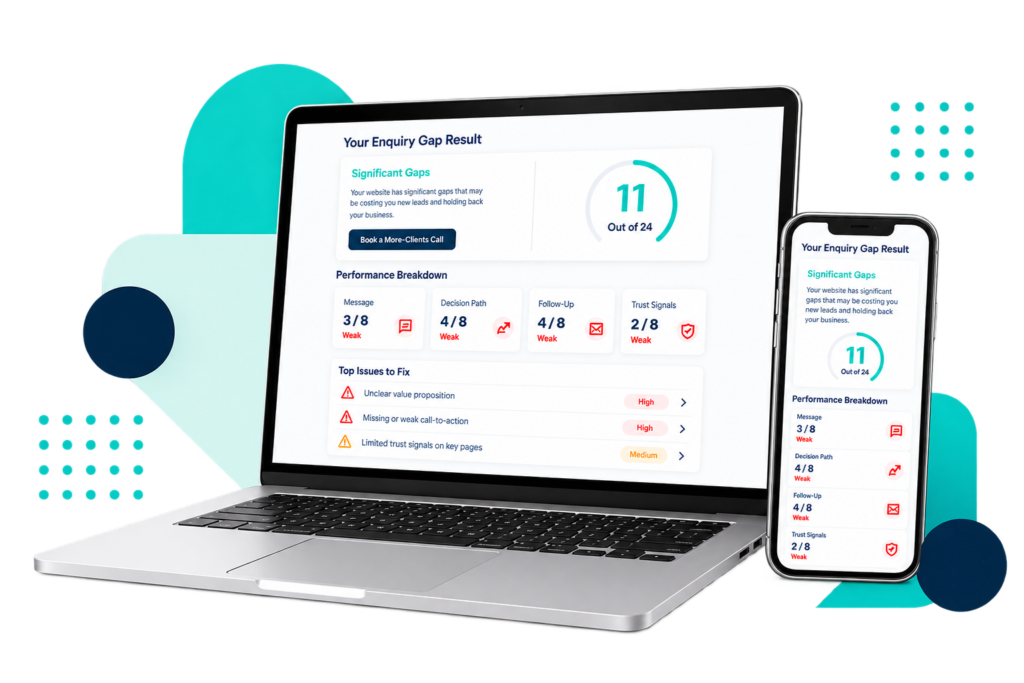
Take the four-minute Enquiry Gap Assessment. It will help you see what is worth checking first before you spend money changing the wrong thing.