

You have had two quotes. One from a local freelancer: £800. One from a specialist agency: £5,000. The briefs you sent both of them said roughly the same thing.
So what explains the difference? And more to the point, how do you know whether the expensive one is worth it or the cheap one is a false economy?
Most agencies will not answer this directly. Doing so either looks like they are justifying their own fees or criticising their competitors. Neither is comfortable.
This article gives you a straight answer. What you get at different price points, what drives a website project up or down, where the traps are, and where we sit within all of this.
In This Article
- Why the same brief produces wildly different quotes
- What a lower-cost website usually includes
- What a higher-cost website usually includes
- What drives the cost up
- What brings the cost down
- Two traps worth knowing about
- Where Krystal Designs fits in
- When a cheaper option might be the right call
- FAQs
Why the Same Brief Produces Wildly Different Quotes
A website quote is not a fixed price for a fixed product. It reflects how much thinking, strategy, writing, building, and support the provider intends to deliver.
Two agencies can produce a website that looks similar on the surface. One spent three hours dropping your logo and service list into a template. The other spent three weeks understanding your buyers, writing copy that addresses their questions, building a page structure that guides visitors toward enquiry, and setting up the systems around it.
Both will send you a website. They will not send you the same thing.
The price difference is rarely about the number of pages. It is about what each page is doing, and whether anyone thought carefully about that before building it.
What a Lower-Cost Website Usually Includes
Lower-cost providers are not all bad. Some are honest about what they offer and deliver it well. But it helps to know what is typically in scope.
At the lower end of the market you will usually find:
Pre-built templates.
The design is chosen from a library and customised with your logo, colours, and content. This can produce something credible, but the structure is generic. It was not designed around how your specific buyers think and decide.
Copy written by you, or barely edited.
Many lower-cost providers design around whatever text you send them. If your current copy is unclear, or focused on what you do rather than why a client should care, it goes straight onto the new website.
Limited strategy.
The project usually begins with “what do you want the site to look like?” rather than “who are your best clients, what brings them to you, and what needs to happen on this site to turn a visitor into an enquiry?”
Basic SEO.
This typically means filling in the page title and meta description fields. It does not mean keyword research, content planning, internal linking, or thinking about how the site competes for relevant searches over time.
Limited support after launch.
Once the site is live, you may be largely on your own for updates, fixes, and improvements.
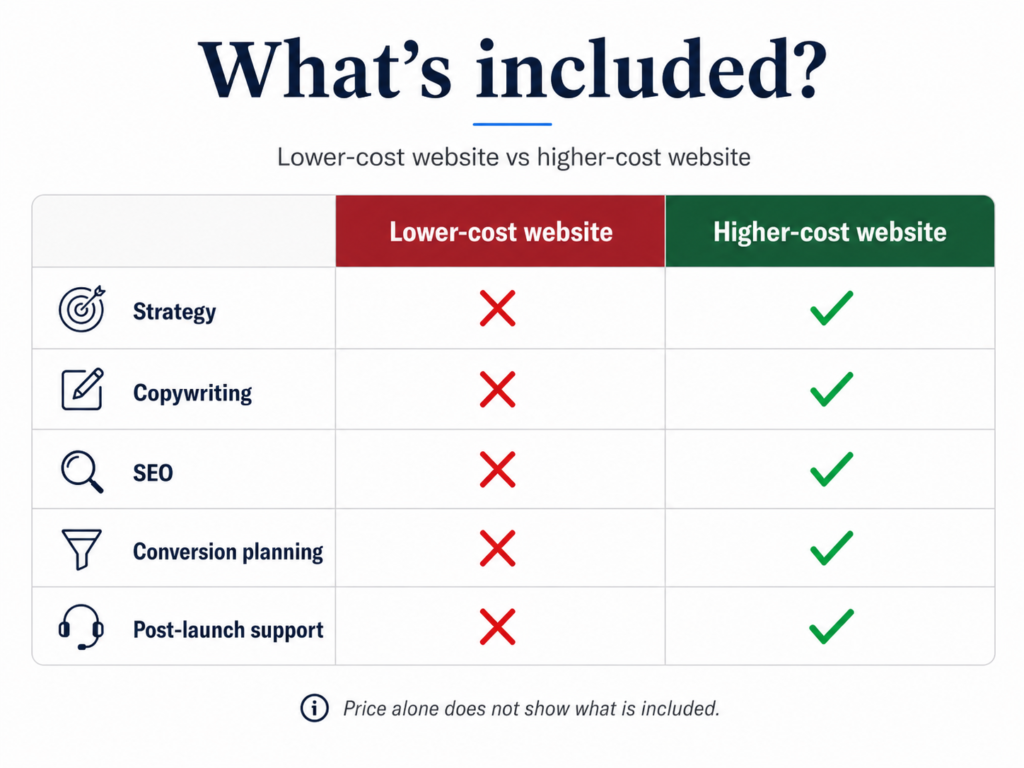
What a Higher-Cost Website Usually Includes
At the higher end, you are paying for more than extra pages. You are paying for the thinking behind them.
Strategy before design.
Before anyone opens a design tool, time is spent understanding your buyers, your services, your competitors, and what needs to happen for someone to move from “I found this firm” to “I am going to get in touch.” This is the part that makes the practical difference.
Professional copywriting.
The site is written around how your ideal client thinks and decides, not around your internal service list. That means addressing the questions they are asking, the concerns they carry, and the proof they need before they will trust you enough to enquire.
Conversion-focused structure.
Every page has a purpose. The headings, sections, calls to action, and proof points are placed with intention, not convenience.
SEO foundations.
Keyword research, page mapping, metadata, internal linking, redirect planning, and a content structure that gives the site a realistic chance of being found for the right searches.
Enquiry systems.
Forms, follow-up processes, and automations that mean an enquiry does not fall through the net after it arrives.
Ongoing support.
The work does not stop at launch. Traffic, conversion, content, and systems are reviewed and improved over time.
What Drives the Cost Up
The biggest cost drivers on any professional services website project are:
- Strategy and positioning. If your message, ideal client, and buyer journey need clarifying, this takes time. A site designed to generate qualified enquiries is more involved than one that displays information.
- Professional copywriting. Writing strong copy for a professional services firm means explaining complex services clearly, building trust, and guiding visitors toward enquiry. If each service page needs fresh copy, the scope increases.
- Number of pages. A focused consultancy with five pages will usually cost less than a law firm with multiple service areas, location pages, team profiles, and a resource section.
- SEO and content structure. If the site needs to rank for competitive search terms, the project includes keyword research, page planning, internal linking, and sometimes supporting articles.
- Conversion tools and enquiry pathways. Lead magnets, booking forms, assessment tools, and segmented enquiry paths add time and complexity.
- CRM and follow-up integration. When enquiries need to flow into a CRM, trigger automated emails, or support a sales process, the project moves beyond a standard website build.
- Proof and trust content. Case studies, testimonials, review sections, and video increase scope. They also tend to have a significant impact on how many visitors actually enquire.
- Ongoing growth support. Content, SEO, reporting, CRO, and optimisation after launch all increase the investment beyond a one-off project.
What Brings the Cost Down
Costs come down when the project is simpler, clearer, and requires fewer moving parts.
- You already have clear positioning. If your services, audience, and message are well-defined, less strategy work is needed.
- You have usable copy and content. Existing service descriptions, case studies, testimonials, team bios, and photography can reduce scope significantly.
- The site has fewer pages. A focused website with a homepage, about page, service page, and contact page will cost less than a large multi-section site.
- You choose a phased approach. Launching the core website first, then adding SEO, automation, and conversion tools later, spreads the investment without sacrificing quality.
- You provide assets promptly. Projects stay leaner when clients provide feedback, approvals, images, and information on time.
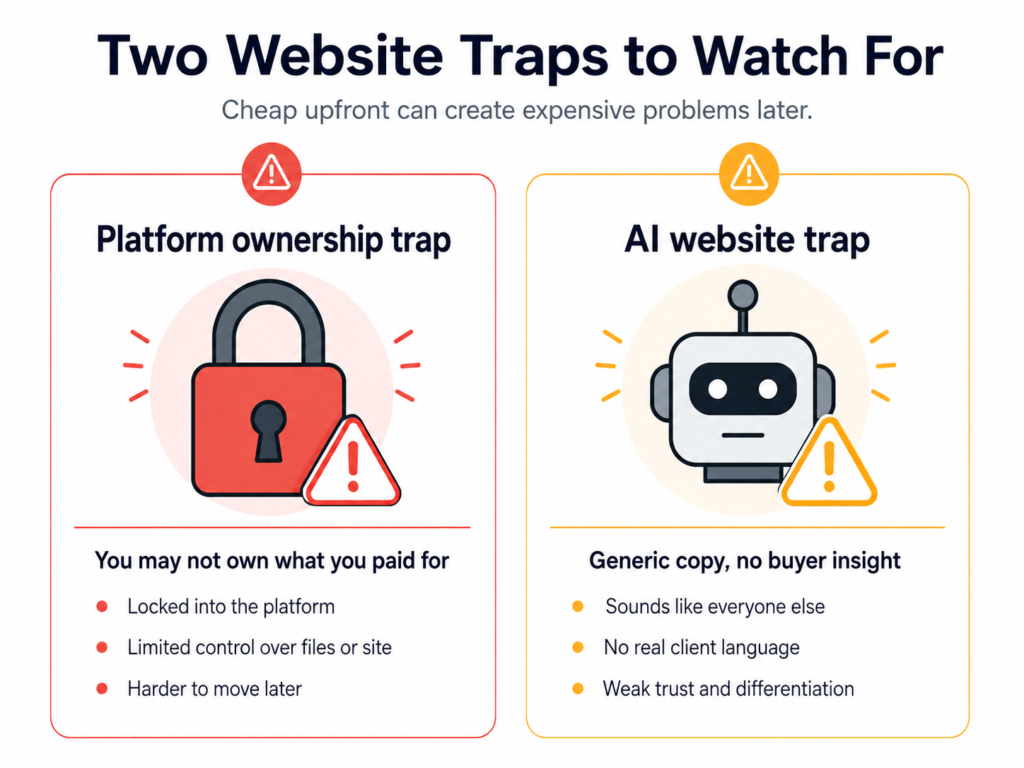
Two Traps Worth Knowing About
Beyond the obvious cost differences, there are two traps that are less visible in a quote.
The platform ownership trap.
Some providers keep prices down by building your website on a closed or proprietary platform they control. The initial cost looks attractive. But if you want to leave later, you may find you cannot take the site with you, cannot access your files and data, and cannot move without rebuilding from scratch.
Before signing anything, confirm that you will own everything outright: the website, the domain, the content, the design files, and all of your data. If the answer is unclear, that is worth exploring further before you commit.
The AI website trap.
Some providers now use AI website builders or AI-generated templates to produce sites quickly. This can be fine for getting a basic presence online.
The limitation is that AI-generated sites tend to rely on generic layouts and generic copy. They may look acceptable, but they usually do not reflect a deep understanding of your buyers, your sales process, your service positioning, or how your firm actually wins work.
AI can be a useful tool in the process. It should not replace strategy, copywriting, conversion planning, or proper follow-up systems.
Where Krystal Designs Fits In
We sit in the conversion-ready website and growth system range. We are not the cheapest option, and we are not trying to be.
Our work is best suited to professional services firms that want their website to become a more consistent source of qualified enquiries. That means we look at more than how the site looks. We look at your message, your buyer journey, your service pages, your proof, your enquiry pathways, and the systems needed to turn visitors into real conversations.
Most of our projects start from £3,500 for a one-off Web Growth Design. That includes strategy, professional copywriting, conversion-focused design, SEO foundations, and launch support.
For firms that want ongoing growth after launch, we offer a monthly Growth Partnership covering SEO, content, conversion optimisation, and enquiry system improvements.
We are not here to overcomplicate the process or sell you things you do not need. Our goal is to help you invest at the right level for the result you actually want.
When a Cheaper Option Might Be the Right Call
A lower-cost website is not always the wrong decision.
If you only need a basic credibility presence and all your work comes from referrals, a simpler site may be adequate for where you are right now.
If you are a newer firm testing your positioning before committing to a full investment, starting lean and building out over time is a sensible approach.
If your message, copy, and proof points are already strong, a lower-cost build around solid content can still perform well.
Where a cheap website tends to be a poor investment is when the problem you are trying to solve is not visibility or credibility, but enquiries. If your current site looks professional and produces nothing, a cheaper version of the same approach will produce the same result. The template is not the issue. The strategy, copy, and systems behind it are.
To Summarise
The difference between an £800 website and a £5,000 one is rarely the number of pages. It is the amount of thinking, strategy, writing, and system-building behind it.
Most professional services firms that have invested in a website and seen no return from it did not get the thinking. They got the pages.
If you are getting quotes now and trying to work out what represents genuine value, the best questions to ask are about strategy and copy, not design. Ask what happens before anyone opens a design tool. Ask who writes the copy and how. Ask what the site will be doing six months after launch to improve its performance.
If you want a straight conversation about what a website project would actually involve for a firm like yours, that is what a More Clients Call is for.