Your website ranks but no calls are coming in. That is one of the most frustrating problems for a professional services firm.
On paper, everything looks like it should be working.
You appear on Google.
You get some traffic.
Your website looks professional.
Your services are clear to you.
But the phone is quiet.
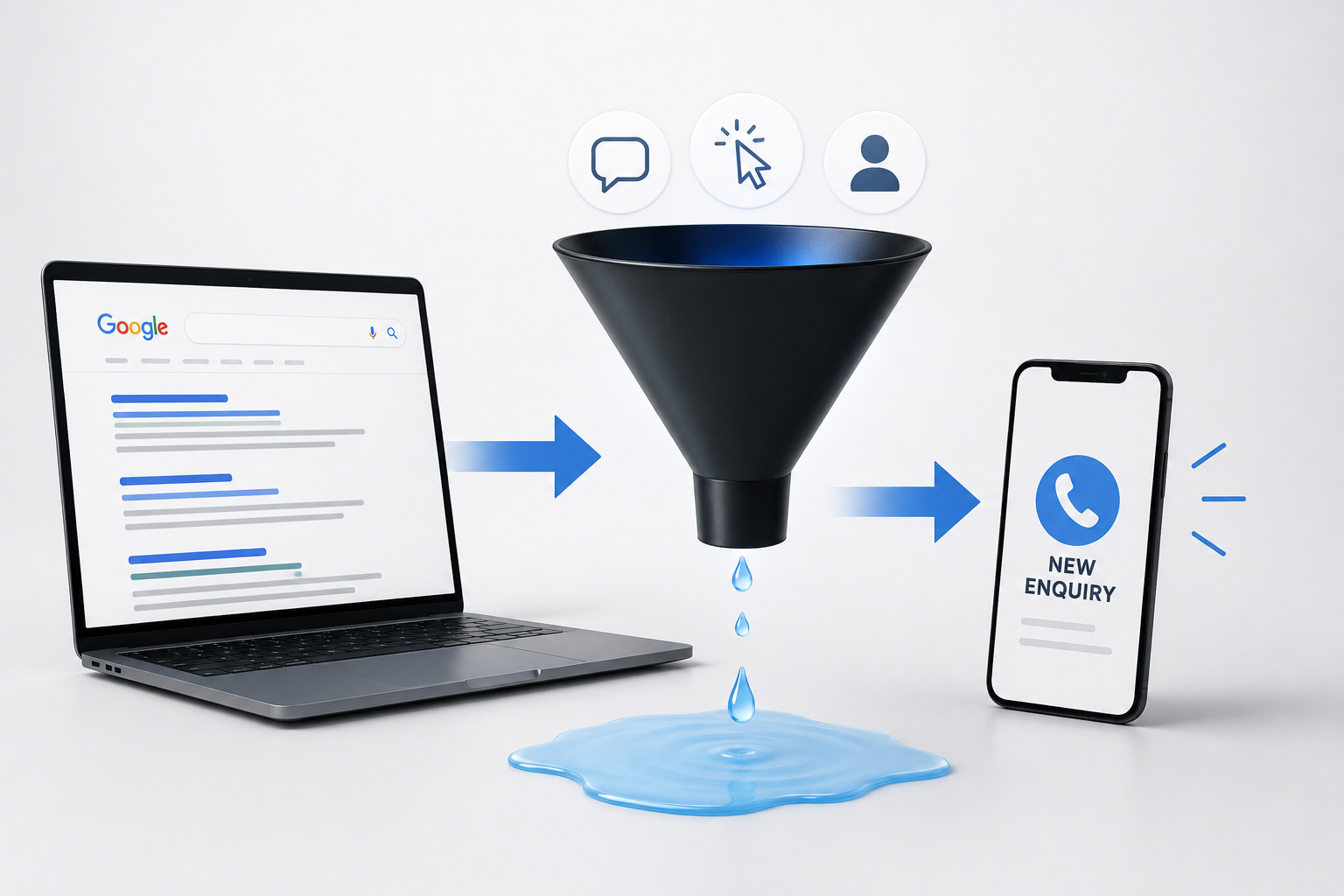
Here’s the awkward bit: page one is not the finish line. It is the start of the decision.
For solicitors, accountants, consultants, financial advisers, and other expert-led firms, rankings alone do not win clients. They get you seen. Then your website has to do the harder job.
It has to make the right person feel understood.
It has to make your firm feel safe to contact.
It has to make the next step obvious.
If that does not happen, people leave. Quietly. Usually without telling you why.
Why page one rankings do not always lead to calls
Ranking on page one means Google has decided your page is relevant enough to show.
That does not mean a buyer has decided your firm is the right choice.
Those are two different jobs.
Google looks at relevance, structure, authority, and usefulness. Your potential client looks at risk, trust, clarity, fit, and timing.
That matters because most professional service buyers are cautious.
They are not impulse buying a pair of trainers. They may be choosing a solicitor for a legal issue, an accountant for their business, or a consultant to fix a costly problem.
Before they call, they are asking:
- Do these people understand my situation?
- Have they helped someone like me before?
- Can I trust them?
- What happens if I contact them?
- Will this be awkward, expensive, or a waste of time?
If your page ranks but does not answer those questions, the ranking does not turn into a call.
What zero-click search means for your firm
Zero-click search means someone searches on Google and gets enough information from the results page without clicking through to a website.
This can happen through:
- AI Overviews
- Featured snippets
- People Also Ask boxes
- Map results
- Reviews
- Knowledge panels
- Local packs
Research from SparkToro and Datos has shown that many Google searches end without a click to the open web. So the job of your content is not only to rank. It also needs to build trust before and after someone clicks.
This does not mean SEO is dead. That phrase needs to be retired, preferably in a locked cupboard.
It means the job of SEO has changed.
You now need to be visible in more places, not only blue links. But when someone does click through, your website has to work harder.
A visitor who reaches your site after seeing AI answers, reviews, maps, and competitor results is usually further into their research.
They are comparing.
That means your page cannot be vague.
It must quickly show:
- who you help
- what problem you solve
- why you are credible
- what they should do next
AI Overviews and featured snippets are changing how people discover information online.
If your website looks like every other firm in your sector, you lose the advantage your ranking created.
The real reason ranked pages fail to convert
Most pages that rank but do not generate calls have one of three problems.
1. The message is too generic
A generic page might rank because it uses the right keywords.
But buyers do not call because of keywords. They call when the page feels relevant to their situation.
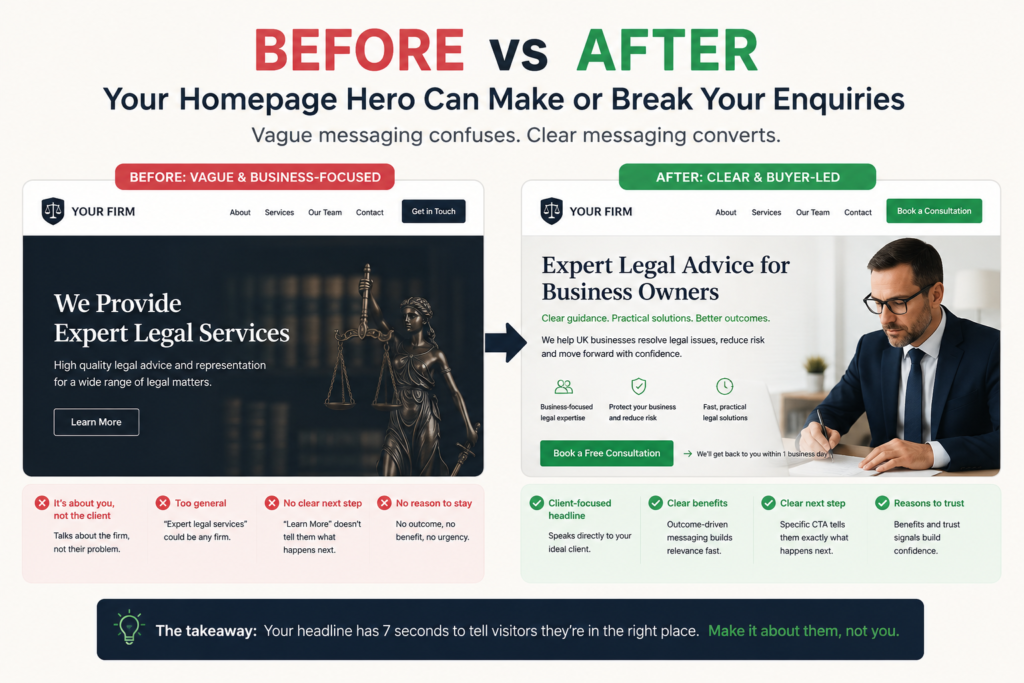
A weak headline might say:
“Expert legal services for individuals and businesses.”
That could apply to hundreds of firms.
A clearer version would say:
“Family law advice for parents who need clear guidance before making their next move.”
That tells the right person they are in the right place.
For professional services, clarity beats clever wording.
Your visitor should know within seconds:
- this is for me
- they understand my problem
- this feels safe enough to explore
If they have to work it out, they leave.
We have seen firms rank well and still get almost no enquiries because the page did not explain who it was for. The traffic was there. The trust was not.
2. The page gives information but no direction
This is common.
The page explains the service. It lists what you do. It might even include FAQs.
But it does not guide the visitor towards action.
The call to action is usually:
“Contact us”
Or worse:
“Learn more”
That is weak because it does not tell the buyer what will happen next.
A stronger call to action gives clarity:
“Book a 25-minute call to find out what to fix first.”
Or:
“Request a call back and we’ll explain your next step.”
People are more likely to act when the step feels simple and low-risk.
3. There is not enough trust where the decision happens
Many websites have testimonials, case studies, accreditations, and reviews.
The problem is that they are often hidden.
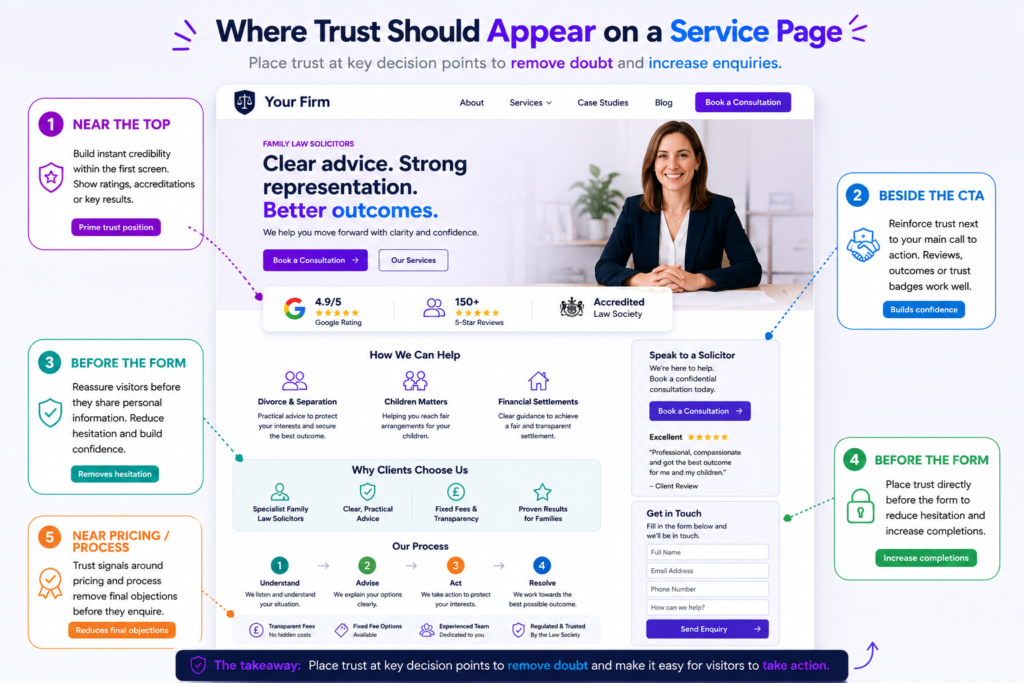
Trust needs to appear close to the point of doubt.
That means adding trust signals:
- near the headline
- beside the main call to action
- above the enquiry form
- near pricing or process details
- on service pages, not only a separate testimonials page
Your visitor should not have to hunt for reasons to trust you.
If they are already unsure, they will not go digging. They will go back to Google.
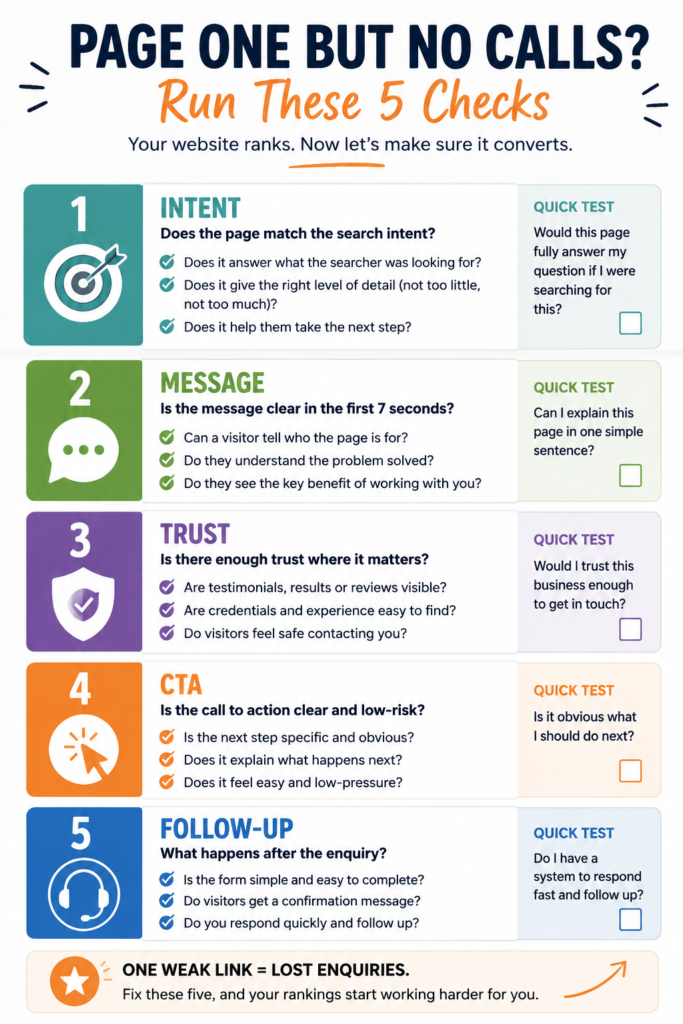
The 5 checks to run on a page that ranks but gets no calls
If one of your pages ranks but brings in little or nothing, start here.
Check 1: Does the page match the search intent?
Ask what the person wanted when they searched. Understanding search intent is often the difference between a page that ranks and a page that generates enquiries.
Were they trying to:
- understand a problem?
- compare options?
- find a local provider?
- check costs?
- take action?
A page can rank and still miss intent.
For example, if someone searches “family solicitor cost UK”, they probably want pricing guidance, ranges, and what affects the fee.
If your page only says “contact us for a quote”, it may rank but still fail.
Give them enough information to feel safe taking the next step.
Check 2: Is the opening section clear within 7 seconds?
Open the page on your phone.
Look only at the first screen.
Can a visitor tell:
- what you do?
- who it is for?
- what problem you solve?
- why they should trust you?
- what to do next?
If not, fix this before you touch anything else.
Your first section should do the heavy lifting.
Check 3: Does the page sound like your buyer?
Most professional service websites sound like they were written for other professionals.
That is the problem.
Your buyers do not always use your technical terms. They use real-life language.
They say:
- “I don’t know what my options are.”
- “I need to know where I stand.”
- “I don’t want this to drag on.”
- “I need someone to explain this properly.”
- “I’m worried I’ll make the wrong decision.”
Your page should use the language your clients use before they become clients.
That is how they recognise themselves.
Check 4: Is the call to action specific?
Vague CTAs create hesitation.
Replace:
“Contact us”
With something clearer:
- “Book a More Clients Through Your Website Call”
- “Request a call back”
- “Ask a question about your case”
- “Find out what your next step should be”
- “Get a clear plan before you spend more on marketing”
The CTA should reduce the pressure to act.
Tell them what happens next.
Check 5: What happens after the enquiry?
This is the part many firms forget.
A ranked page might generate some enquiries, but those enquiries can still go cold.
Check:
- Do form submissions arrive instantly?
- Does the visitor get a confirmation message?
- Does the thank you page explain what happens next?
- Does someone respond quickly?
- Is there a follow-up if they do not reply?
- Are calls tracked?
- Are missed calls handled?
If not, your website may be earning opportunities that your follow-up process loses.
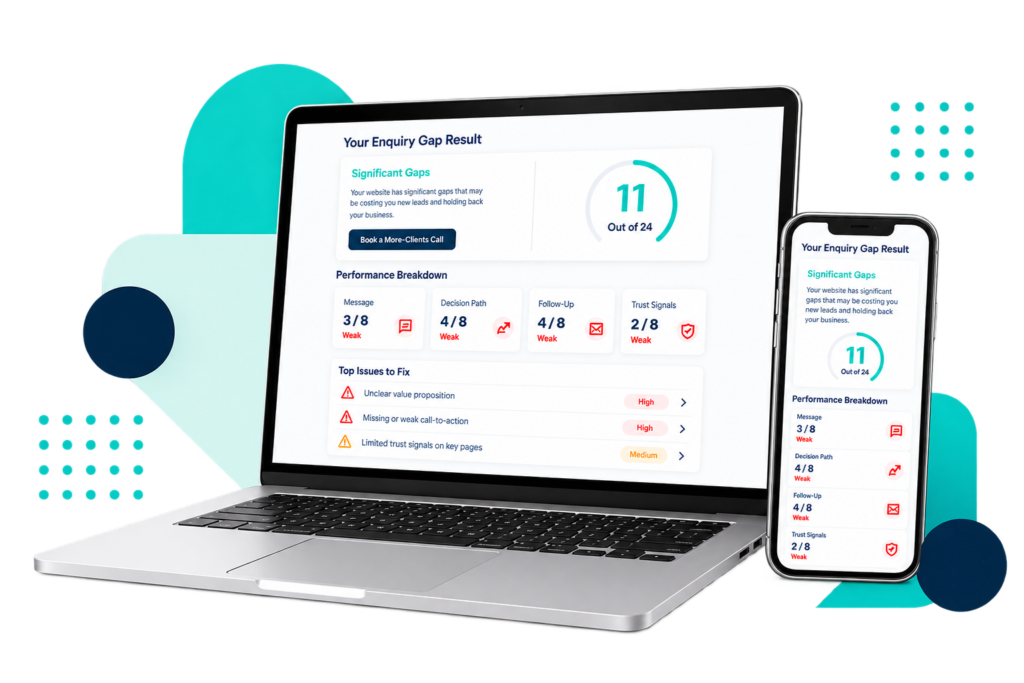
This is why we look at three things first: message, decision path, and follow-up. That is the foundation of EnquiryOS™. If one of those parts is weak, rankings alone will not turn into enquiries.
How to turn rankings into enquiries
Here is the order I would follow.
Step 1: Fix the message first
Do not start by adding more sections, more design, or more content.
Start with the core message.
Use this simple structure:
“We help [type of person] with [specific problem] so they can [desired result].”
Example:
“We help established professional firms turn their website into a steady source of better-fit enquiries.”
That is clear. It says who it is for, what problem it solves, and what outcome matters.
Step 2: Build the page around buyer questions
Your page should answer the questions people ask before they enquire.
For a professional service page, that usually includes:
- Can you help with my exact problem?
- What does the process look like?
- How much might this cost?
- How long does it take?
- What makes you different?
- Who will I speak to?
- What should I do next?
Do not dodge the difficult questions.
The firms that answer them clearly usually win more trust.
Step 3: Add trust where hesitation happens
Do not save all your trust signals for the bottom of the page.
Use:
- review snippets
- case study links
- client outcomes
- years of experience
- recognised memberships
- named team members
- process snapshots
- short quotes from clients
Place them close to the decision points.
Trust is not decoration. It helps people move.
Step 4: Make the next step low-risk
A cautious buyer does not want to feel trapped.
So make the next step feel simple.
Tell them:
- how long the call takes
- who they will speak to
- what they will get from it
- whether they need to prepare anything
- when they can expect a response
For Krystal Designs, the best fit is:
“Book a More Clients Through Your Website Call.”
Frame it as a diagnostic call.
The goal is to show them what is blocking enquiries before they spend more money on SEO, ads, or another redesign.
Step 5: Track calls and forms properly
You cannot improve what you cannot see.
Track:
- form submissions
- phone calls
- booked calls
- source of enquiry
- page that generated the enquiry
- lead quality
- follow-up status
Traffic is useful. But for a professional service firm, the real question is:
“How many real enquiries did the website generate this month?”
That is the number that matters.
Conclusion
Ranking on page one feels like a win.
And it is.
But it is not the whole job.
If your website ranks but no calls come in, the problem is rarely one single thing. It is usually the journey after the click.
Your message is not clear enough.
Your trust signals are not strong enough.
Your next step is too vague.
Your follow-up is too slow or too loose.
For professional service firms, this matters because buyers are cautious. They compare. They read. They worry about making the wrong choice.
Your website has to help them move from unsure to confident.
That does not mean shouting louder. It means making the page clearer, safer, and easier to act on.
My recommendation is simple: before you spend more on SEO, ads, or another redesign, check whether your existing ranked pages are doing their job.
- Start with one page.
- Look at the message.
- Look at the decision path.
- Look at the follow-up.
That is where the calls are usually getting lost.
If you want a clear outside view, book a More Clients Through Your Website Call. We’ll show you what is blocking enquiries and what to fix first.