

A pricing guide for professional services firms that want enquiries, not just a website.
Are you confused by website quotes ranging from £500 to £25,000 — and wondering which one’s actually right for your firm?
Why do some professional services firms pay thousands for a new site, only to end up with something that looks good but generates no new enquiries?
This guide explains exactly what drives the cost of a professional services website in the UK, what to expect at different price points, and how to budget in a way that delivers measurable ROI.
By the end, you’ll understand:
- Typical website cost ranges for professional services firms
- What drives price up or down (and hidden costs to avoid)
- The difference between brochure sites vs enquiry systems
- Questions to ask any provider before signing a contract
- Real-world examples of firms who turned websites into enquiry engines
Where Krystal Designs typically sits
At Krystal Designs, most of our professional services website projects sit in the Conversion-Ready Website or Growth System range.
Our Web Growth Design starts from £3,500 + VAT. For firms that want a full growth system from day one, projects typically sit between £5,000 and £10,000 depending on scope.
We are not usually the cheapest option, and we are not trying to be. Our work is designed for firms that want their website to generate qualified enquiries, not just look professional online.
That means our projects usually include strategy, messaging, copywriting, conversion-focused design, SEO foundations, enquiry capture, analytics, and launch support.
For firms that want ongoing growth, this can expand into a full marketing engine with content, lead magnets, CRM follow-up, automation, reporting, and optimisation.
If you only need a simple online presence for referrals, a lower-cost starter website may be enough. But if your website needs to become a consistent source of qualified enquiries, you should expect to invest in the middle or upper ranges explained below.
The Short Answer
- Basic DIY website: £500–£1,500
- Conversion-ready website: £4,500–£9,500
- Full growth system (website + marketing engine): £10,000–£25,000+
The real question isn’t “How much does it cost?” but “How soon will it pay for itself?”
Why websites cost more than they used to
A few years ago, many professional services websites were little more than online brochures: a homepage, an about page, a few service pages, and a contact form.
Today, buyers expect more.
They want clear answers before they enquire. They compare firms online. They read reviews, check case studies, look for proof, and expect a smooth experience on mobile. Search engines also expect better structure, faster websites, helpful content, and stronger technical foundations.
That means a website built to generate enquiries now usually needs more than design. It needs strategy, copywriting, SEO structure, conversion planning, trust signals, analytics, and often some form of follow-up system.
This is why a website that cost £2,000 several years ago may now cost more if it is expected to compete, rank, convert, and support growth.
Where your website investment usually goes
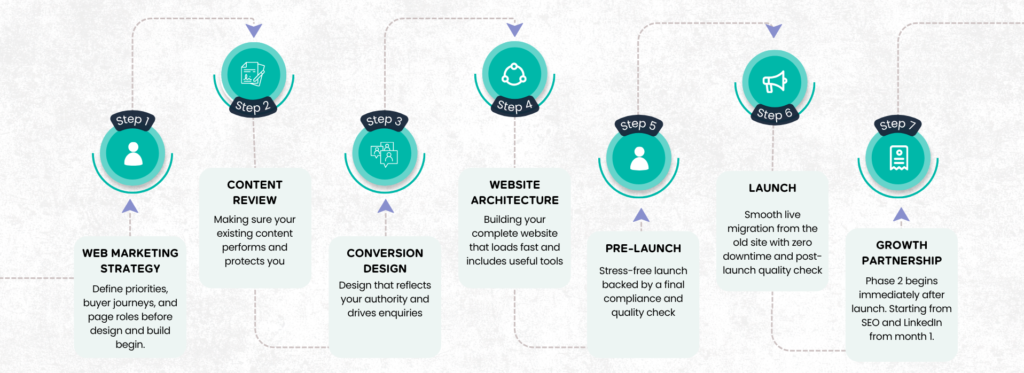
| Area | What it covers |
|---|---|
| Strategy | Positioning, buyer journey, service clarity, page planning, conversion goals |
| Copywriting | Homepage copy, service pages, FAQs, proof, calls to action, objection handling |
| Design | User experience, visual direction, mobile layouts, trust signals, page flow |
| Development | Website build, forms, speed, technical setup, testing, integrations |
| SEO | Keyword research, metadata, redirects, site structure, local SEO foundations |
| Conversion | CTAs, enquiry pathways, lead capture, booking journeys, form strategy |
| Launch | Analytics, tracking, checks, training, handover, post-launch support |
A cheaper website usually reduces or removes some of these areas. That may be fine if you only need a simple online presence. But if the goal is to generate better enquiries, these are the parts that make the website perform.
What drives the cost up?(and why it varies)
- Scope & pages (service areas, practice hubs, FAQs, location pages)
- Content (professional copywriting, photography, thought-leadership)
- Conversion design (layouts, CTAs, booking flows, enquiry forms)
- Integrations (CRM, calendars, payments, marketing automation)
- Compliance & trust (GDPR, accessibility, accreditations, reviews)
- Migration & SEO (redirects, site speed, structured data, Core Web Vitals)
What can bring the cost down?
The cost of a professional services website is usually lower when the project is simpler, clearer, and has fewer moving parts.
Costs may come down if:
- Your services, audience, and positioning are already clear
- You already have usable copy, photography, testimonials, and case studies
- You only need a small number of core pages
- You do not need advanced SEO at launch
- You do not need CRM, booking, payment, or automation integrations
- You are happy to use a simpler design structure
- You want to phase the work over time instead of building everything at once
For example, a consultant with one core service and strong existing content will usually need a smaller project than a multi-service firm with several locations, multiple buyer types, and no existing content.
The key is not to cut corners that affect trust or enquiries. The best way to reduce cost is to simplify the scope while protecting the parts that actually help visitors become leads.
Tip: If a quote is very cheap, check what’s missing from this list. That’s usually where the “cost” hides.
Three Common Packages (and What You Actually Get)
| Package | Suitable for | What’s included | Typical Investment | Not right for |
| Starter “Credibility” Site | New/solo practices, referral-driven firms | Branded template, 5–8 pages, basic forms, light SEO, DIY content | £1,500–£4,000 (one-off) | Firms that need consistent online enquiries, SEO growth, or strong conversion strategy |
| Conversion-Ready Website | Established firms wanting steady enquiries | Strategy, conversion design, copywriting for key pages, reviews/case studies, local SEO, CRM/form routing, analytics, launch checklist | £4,500–£9,500 (one-off) | Firms that only want a cheap brochure site or are unwilling to invest in copy, proof, and positioning |
| Growth System (Website + Engine) | Growth-focused firms | Everything above plus lead magnets, landing pages, blog setup, schema, advanced tracking, automation, nurture sequences, retargeting campaigns | £10,000–£25,000+ (project) | Firms that are not ready for ongoing marketing, follow-up, reporting, or optimisation |
Our Growth System work is built on a framework called EnquiryOS™. It addresses the three reasons professional services websites fail to generate enquiries: Message, Decision Path, and Follow-Up. Every project we take on is structured around these three stages, in that order.
Tip: If budget is tight, fix conversion first (so existing traffic enquires), then layer in SEO, then scale with ads/social.
Does pricing change by type of professional services firm?
Yes. A five-page consultant website is very different from a multi-location law firm, accountancy practice, private clinic, or architectural firm.
The more services, locations, trust signals, compliance needs, enquiry pathways, and integrations required, the more the project usually costs.
| Firm type | Typical complexity | Why pricing may vary |
|---|---|---|
| Consultant or coach | Low to medium | Fewer pages, simpler offer, lighter SEO |
| Accountant | Medium | Service pages, local SEO, trust proof, guides, lead magnets |
| Law firm | Medium to high | Practice areas, compliance, reviews, multiple offices, consultation pathways |
| Private clinic | Medium to high | Booking, compliance, trust, treatments, location SEO |
| Architect or design firm | Medium | Portfolio, case studies, visuals, credibility proof |
| B2B consultancy | Medium to high | Complex services, long sales cycle, proof, lead nurturing |
One-Off vs Ongoing Costs
One-off (build): as per the packages above.
Ongoing (performance):
| Item | Typical Ongoing |
| Hosting | £10–£50/month |
| Care plan (updates, fixes) | £79–£249/month |
| Licences (plugins/tools) | £0–£50/month |
| SEO/content (optional) | £600–£2,500+/month |
| Ads management (optional) | £500–£2,000+/month + ad spend |
Tip: SSL certificates should be free (via Let’s Encrypt). Don’t pay extra for basic HTTPS.
Can the investment be phased?
Yes. Not every firm needs to build everything at once.
A common phased approach is:
Phase 1: Strategy, messaging, core website, enquiry pathways, and analytics
Phase 2: SEO content, lead magnets, case studies, and conversion improvements
Phase 3: CRM integration, automation, nurture sequences, ads, and ongoing optimisation
This approach can make the investment easier to manage while still building toward a proper growth system.
Some firms prefer a one-off project. Others prefer a smaller initial build followed by monthly growth support. The right structure depends on your budget, goals, and how quickly you want the website to start contributing to enquiries.
Why are some website companies so cheap, while others are expensive?
Cheaper website companies are not always bad. If you only need a simple online presence, a lower-cost provider may be a perfectly sensible choice.
However, cheaper providers often keep costs low by:
- Using pre-built templates
- Asking you to provide the copy
- Including little or no strategy
- Offering only basic SEO
- Skipping conversion planning
- Avoiding CRM, booking, or automation integrations
- Providing limited support after launch
- Relying heavily on AI-generated layouts or copy
- Tying you into their own platform, hosting, or system
That last point is important. Some providers offer a low upfront price, but the trade-off is lock-in. Your site may be built on a closed platform, hosted only with them, or structured in a way that makes it difficult to move elsewhere. If you ever want to leave, rebuild, change provider, or take full control of your website, you may discover you do not own as much as you thought.
More expensive providers usually cost more because they are not just building pages. They are helping you build a client-generation system. That may include strategy, messaging, copywriting, SEO, conversion design, enquiry capture, analytics, CRM integration, follow-up, and ongoing optimisation.
The right choice depends on what you need the website to do. If it only needs to prove you exist, cheaper may be fine. If it needs to generate qualified enquiries, the missing pieces in a cheap website can become expensive later.
When a conversion-ready website may not be worth it
A £4,500–£9,500+ website may not be the right investment for every firm.
It may not be worth it if:
- You get all the work you need from referrals
- You do not want or need online enquiries
- You only need somewhere for people to check you are legitimate
- You are not ready to follow up with enquiries properly
- Your services or offer are still unclear
- You mainly want a prettier version of your current website
- You are not prepared to provide input, feedback, proof, or expertise during the project
In these situations, a simpler starter website may be the better financial decision.
But if your current website is not explaining your value clearly, not converting enough visitors, not supporting your sales process, or not helping you generate the right enquiries, then a more strategic website is usually the better investment.
ROI: Brochure Site vs Enquiry System
| Website Type | What You Get | ROI Impact |
| Brochure Website | Polished design, 5–8 pages, light SEO, minimal conversion tools | Low — looks credible, but generates few enquiries |
| Conversion-Optimised Website | Strategy, SEO, CRO, reviews, enquiry tools, CRM integration | High — consistent enquiries, measurable ROI, pays for itself in months |
Example: If one new client per month is worth £1,200 in margin, an extra 2–3 enquiries per month covers a £7–£9,000 site quickly.
Results in Practice
Fountain Solicitors – Their old “brochure” site looked professional but delivered few leads. After relaunching with strategy, SEO, and conversion tools, they now generate 60+ enquiries per month and scaled from 1 to 5 offices.
DCA Refinishing – No existing website and no ad spend. After building their site on SEO foundations, they now have 135 keywords ranking and are fully booked three months in advance.
Conclusion: How Much Should You Spend?
If referrals drive most of your work and you only need a credible online presence, a Starter Site may be enough.
If you want your website to generate more consistent, qualified enquiries, a Conversion-Ready Website is usually the minimum level worth considering.
If growth is the goal, and you want your website, content, SEO, follow-up, and reporting working together, then a Growth System is usually the better long-term investment.
The right choice depends on what you need the website to do. A cheap website is not always bad. But a cheap website that generates no enquiries can become very expensive over time.
If you’d like to see how these cost ranges apply to your firm, visit our Pricing Page, where we break down the options by firm size, website goals, and growth priorities.
Final Thought: A “cheap” site is expensive if it generates no enquiries. The right site pays for itself — and keeps paying back.