The proposal sounded convincing. The agency understood legal marketing, the presentation looked polished, and the reports promised visibility, traffic and growth.
Months later, you were still trying to work out what had actually changed. Perhaps you paid for SEO but could not connect it to a single suitable matter.
Maybe a website redesign looked better but produced the same number of enquiries. Perhaps the agency became harder to reach once the agreement was signed.
Now you are asking a fair question:
Does online marketing work for solicitors, or is it another expense that creates activity without new clients?
And if it does work, how can you tell whether the next provider will be any different from the last one?
This article gives you a practical way to judge online marketing before you commit again. It explains where it works, where it is overpromised and what should remain visible after you sign.
The aim is not to persuade you to trust marketing again. It is to help you evaluate it without relying on blind trust.
Key takeaways
- Online marketing can generate suitable enquiries for solicitors, but one channel cannot carry the full client journey.
- Previous campaigns often fail because the provider prescribed its service before identifying the real problem.
- Rankings, clicks and form completions only matter when they connect to suitable enquiries and new matters.
- A good provider makes the work, responsibilities, ownership and review points visible after signing.
- You should understand what failed before deciding what to buy next.
Does online marketing really work for solicitors?
Yes, online marketing can work for solicitors. It works when it helps the right person move through a complete route.
That route usually looks like this:
- They find your firm.
- They recognise that you handle their situation.
- They find enough useful information to continue.
- They feel confident about taking the next step.
- Their enquiry reaches the right person.
- Your firm responds properly.
- The enquiry becomes a suitable matter.
The problem is that most marketing services focus on one part of that route. An SEO agency may increase rankings, while a Google Ads provider may generate clicks.
A web designer may improve the appearance of the website. A social media provider may increase reach.
Those activities can contribute to growth, but they do not become a reliable client-acquisition route simply because they run at the same time. The full route still needs to work.
A strong search campaign can fail when the page does not answer the visitor’s questions. A good website can lose opportunities when its forms send enquiries to an old inbox.
This is why the first question should not be:
Which marketing channel should we buy?
Start with:
What is stopping the right person from becoming a suitable enquiry?
That question gives you a better chance of fixing the actual problem. It also reduces the risk of buying another service that does not address the main constraint.
Where online marketing works well
Online marketing is strongest when it matches how people already search for and choose legal help. The channel needs to suit the buyer, the practice area and the situation.
It reaches people who do not already know your firm
Referrals remain valuable, but a referred person may still search for your firm. They may read your reviews and compare your website with another solicitor.
Online marketing can also reach people outside your existing network. This gives your firm another route to suitable enquiries.
For example, someone dealing with an urgent immigration matter may search for a solicitor immediately. A commercial director may spend weeks reading specialist guidance before making contact.
Both can become clients through online marketing, but their routes will look different. The marketing should reflect that difference.
It answers questions before the first conversation
Legal services involve risk, cost and uncertainty. Potential clients often want answers before they feel ready to contact a firm.
They may want to understand:
- whether you handle their situation
- who will work on the matter
- what the process involves
- what might affect the cost
- what information they need
- what happens after they contact you
Useful pages and articles can answer those questions before your team speaks to them. This helps the right person arrive better informed.
It may also filter out enquiries your firm cannot help. That can save time for both the potential client and your team.
Our article on why law firm websites fail to turn visitors into clients explains how unclear pages and weak enquiry routes can undermine otherwise useful marketing.
It supports different practice areas differently
Family law, conveyancing and commercial litigation should not use the same marketing route without question. Different buyers search, compare and enquire in different ways.
A local consumer service may depend heavily on search and Google Business Profile visibility. A specialist commercial practice may gain more from sector articles, LinkedIn distribution and professional referral relationships.
Online marketing works best when the channel follows the buyer’s behaviour. The channel should not be chosen because the agency happens to sell it.
It can be measured
Online marketing gives your firm the ability to record what happened before and after an enquiry. This can make marketing easier to evaluate.
You may be able to record:
- which page someone visited
- which campaign led to contact
- which practice area they needed
- whether the enquiry was suitable
- whether a meeting was booked
- whether a matter was opened
That does not happen automatically. The website, tracking and internal intake process need to connect.
When they do, you can see which activity contributes to the work your firm wants. You can also see which activity needs changing.
Why law firm marketing often disappoints
Online marketing is often overpromised as a collection of tactics. The agency recommends SEO, advertising, social media or a new website before identifying what is actually failing.
Several common problems follow.
The diagnosis matches the service being sold
An SEO agency sees a ranking problem. A web designer sees an outdated website.
An advertising agency sees insufficient traffic. One of those views may be correct, but the conclusion should follow the evidence.
Your firm may already have enough visitors. The real problem could be unclear service pages, a difficult form or poor follow-up.
Buying more traffic will not fix those problems. It may make the existing failure more expensive.
A provider should be able to explain why its recommendation comes first. The answer should include evidence from your current position, not a general claim about what works for law firms.
The report stops before the commercial result
A monthly report may show keyword movement, website sessions or advertising clicks. It may also include recorded conversions and social engagement.
These numbers can help explain what is happening. They do not tell you whether the firm gained suitable new work.
A conversion could be a button click. A form submission could be spam.
A phone call could concern a service you do not offer. Your reporting should eventually connect activity to a commercial result.
That may include:
- suitable enquiries
- booked conversations
- matters opened
- cost per suitable enquiry
- cost per new matter
The provider cannot do this alone. Your team also needs to record what happened after each enquiry.
Nobody owns the complete route
One supplier manages SEO, while another controls the website. A third runs advertising, and your team handles enquiries.
Each person completes their task, but nobody takes responsibility for what happens between them. When results are weak, everyone can point elsewhere.
A useful marketing relationship makes responsibility clear. You should know who owns each part of the route.
That includes:
- who checks the page
- who tests the form
- who monitors the campaign
- who responds to enquiries
- who records the outcome
- who decides what changes next
This is also why account and asset ownership matters. Your firm should know what it owns and where the important access details sit.
Our guide to agency warning signs for law firms covers the questions to ask about access, responsibility and what happens after signing.
The work becomes difficult to inspect
Many disappointed buyers describe a similar pattern. They felt impressed before signing and confused afterwards.
Updates became vague and reports required interpretation. The agency asked for more time but did not explain what it was learning.
Marketing can take time, but the work should remain visible while you wait. You should understand what has happened and what comes next.
You should be able to see:
- what has been completed
- why it was prioritised
- what changed
- what the early signs show
- what will be reviewed next
- what happens if performance stays weak
The goal is not constant activity. It is enough visibility to judge whether the work is moving in the right direction.
Evidence that recovery is possible
A poor agency experience does not mean online marketing cannot work for your firm. It often means the previous work left damage that needs to be identified before anything new begins.
Krystal Designs worked with an established UK service business after a previous website rebuild damaged its search visibility. The new website looked acceptable, but organic performance had fallen and the enquiry route had weakened.
The first task was not to launch another campaign. The work began by identifying what had been lost during the rebuild.
Search visibility, page structure and the route to enquiry were then repaired in the correct order. The business recovered its organic visibility and began rebuilding its enquiry flow.
This example does not show that every failed campaign needs a new website. It shows that recovery starts by finding what the previous work damaged or failed to address.
A new provider should not ask you to forget what happened before. They should help you understand it.
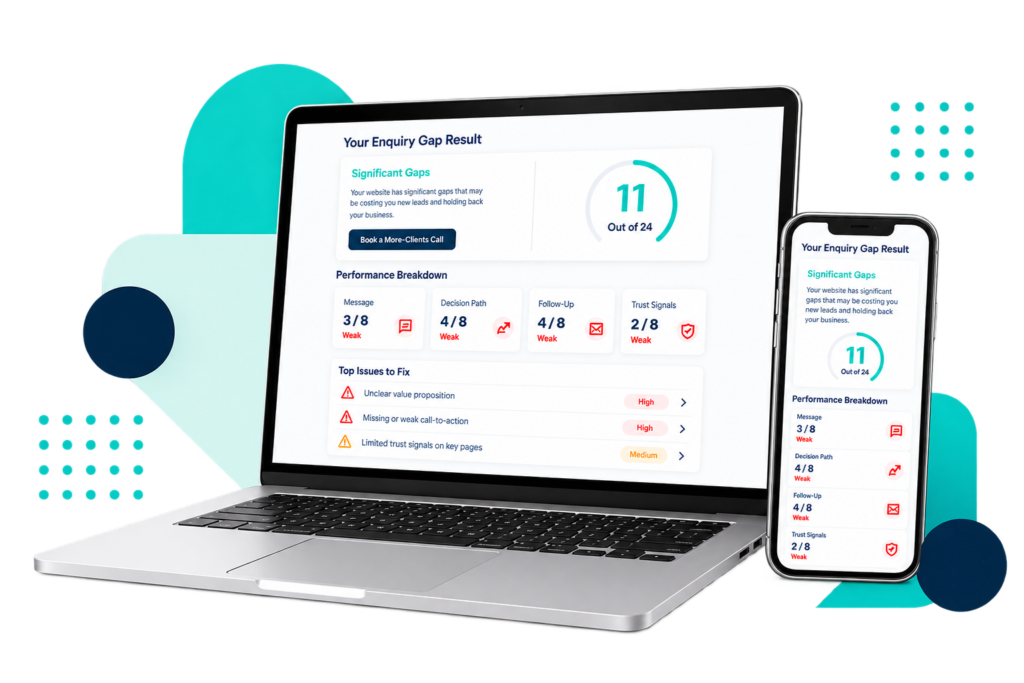
At Krystal Designs, we use EnquiryOS™ to examine the message, the route to enquiry and what happens after contact. The framework gives the review a structure without predetermining the service you need.
The output may show that your firm needs stronger visibility. It may show that your website needs work first.
It may also show that enquiries are already arriving but disappearing after contact. The recommendation should follow what the evidence shows.
What to check before choosing another agency
You do not need another promise that this agency is different. You need a relationship you can inspect while it is happening.
Ask the following questions before signing.
What do you believe is actually failing?
The provider should explain the problem in terms you can evaluate. Be cautious when the answer is a broad statement without evidence.
Examples may include:
- your rankings are too low
- your website looks old
- you need more content
- competitors are spending more
- your adverts need a bigger budget
Those may be symptoms rather than the main problem. Ask what evidence shows they are the main constraint.
Why should this be fixed first?
Marketing contains many possible improvements. A useful provider can explain why one deserves priority.
For example, improving a service page may come before increasing ad spend. That may be because the current page receives traffic but produces few genuine enquiries.
The reasoning should remain visible. You should understand why the work is happening in that order.
What will we own?
Your firm should know who controls the main digital assets. This should be clear before work begins.
Those assets may include:
- the domain
- hosting
- website
- advertising accounts
- analytics
- Search Console
- Google Business Profile
- tracking numbers
- written content
- form data
- CRM records
A provider may manage these assets on your behalf. Your firm should not become dependent on their permission to access them.
Who is responsible after signing?
Ask who owns each task and decision. You need more detail than the name of an account manager.
You should know who:
- approves the plan
- completes the work
- checks quality
- tests the enquiry route
- reviews performance
- responds when something fails
A clear responsibility map reduces confusion. It also makes it easier to act when a problem appears.
When will we review progress?
Agree review points before the work begins. Different activities need different timeframes.
Every engagement should still include moments when you assess:
- what has changed
- whether the early assumptions remain valid
- what the data shows
- whether the priority needs adjusting
- what happens next
This gives you a way to evaluate the relationship before months pass without a clear decision.
What happens when it is not working?
This is one of the most useful questions you can ask. The answer should explain how the provider investigates weak performance.
It should also explain what decisions may follow. A vague request for patience is not a response plan.
For more due-diligence questions, read 21 questions to ask before hiring a law firm web designer.
The honest verdict
Online marketing works for solicitors when the right parts work together. It can help your firm become easier to find, answer buyer questions and generate suitable enquiries outside your existing network.
But it is often overpromised. SEO cannot repair a weak enquiry process, and advertising cannot make an unclear page persuasive.
A website redesign cannot improve results when nobody has defined what the site needs to do. The safest next step after a poor agency experience is not to choose another tactic quickly.
Understand what failed, check what you own and find the main constraint. Then decide what work is justified.
You should not have to become less cautious. A good marketing relationship should make your caution useful.
Book a More Clients Call
You may need stronger visibility, or you may have a website problem. You may also have an unclear enquiry route or work from a previous agency that needs reviewing.
You should not have to guess which one it is. Book a More Clients Call and we will look at what has happened so far.
We will review where the current route may be failing and what should be checked first. You will leave with:
- a clearer view of the likely problem
- the main area to investigate
- the questions to ask before spending more
- an appropriate next step based on your situation
25 minutes. A practical review with clear answers.