

There is no single answer to the question, “what is a new client worth to my business?” It depends on your average client value, your profit margin, how often clients return and how your firm actually makes money.
That might sound like an annoying answer. It is also the honest one.
A new client might be worth £500 to one business and £15,000 to another. Both numbers can be right, but only if they are based on real clients rather than a number that sounds impressive.
This matters because you cannot judge whether fixing your enquiry problem is worth it until you know what a good client is actually worth.
If one more good client is worth £600, the decision looks one way. If one more good client is worth £6,000, even a small improvement in enquiries can change the maths quickly.
Here is how to work out your number using real figures.
Key Takeaways
- There is no universal answer to what a new client is worth
- Your own recent clients are the best place to start
- Big outlier clients can make the numbers misleading
- Revenue and profit tell you different things
- This number helps you decide whether fixing enquiries is worth the effort
Why This Number Matters
Most firms talk about wanting more enquiries. Fewer stop to ask what a good enquiry is actually worth.
That matters because not every enquiry has the same commercial value. One extra client a month can be a small improvement for one firm and a serious growth lever for another.
If your average good client is worth £1,000 in first-year revenue, then two extra clients a month could mean £24,000 a year in added revenue. If your average good client is worth £5,000, those same two clients could mean £120,000 a year.
That is why the number matters.
It does not give you a perfect forecast. It gives you a better way to judge whether fixing your website, enquiry process or follow-up is worth paying attention to.
Without it, every decision about marketing spend becomes harder than it needs to be.
What Affects the Value of a New Client?
The value of a new client depends on the type of work you do. A one-off service is worth something very different to a client who comes back repeatedly or refers others.
It also depends on the size and shape of your firm. A commercial law firm, accountancy practice, consultancy, dental practice or local service business will all have different numbers.
The way the client arrives matters too.
A referred client may not have an obvious ad cost. But referrals still depend on time, relationships and a network you may not fully control.
A client from Google Ads or SEO may have a clearer acquisition cost. That makes it easier to compare what you spent with what came back.
Neither source is automatically better. The point is to understand the value clearly enough to make better decisions.
Start With First-Year Client Value
For this article, keep the calculation simple. Start by working out your average first-year client value.
That means the amount a new client usually pays you in their first 12 months.
This is simpler than full customer lifetime value. Lifetime value looks years ahead, which can be useful, but it is harder to calculate honestly if you do not already track it.
First-year value is more practical. It helps you judge near-term decisions without needing a complicated spreadsheet.
How to Calculate Your Own Number
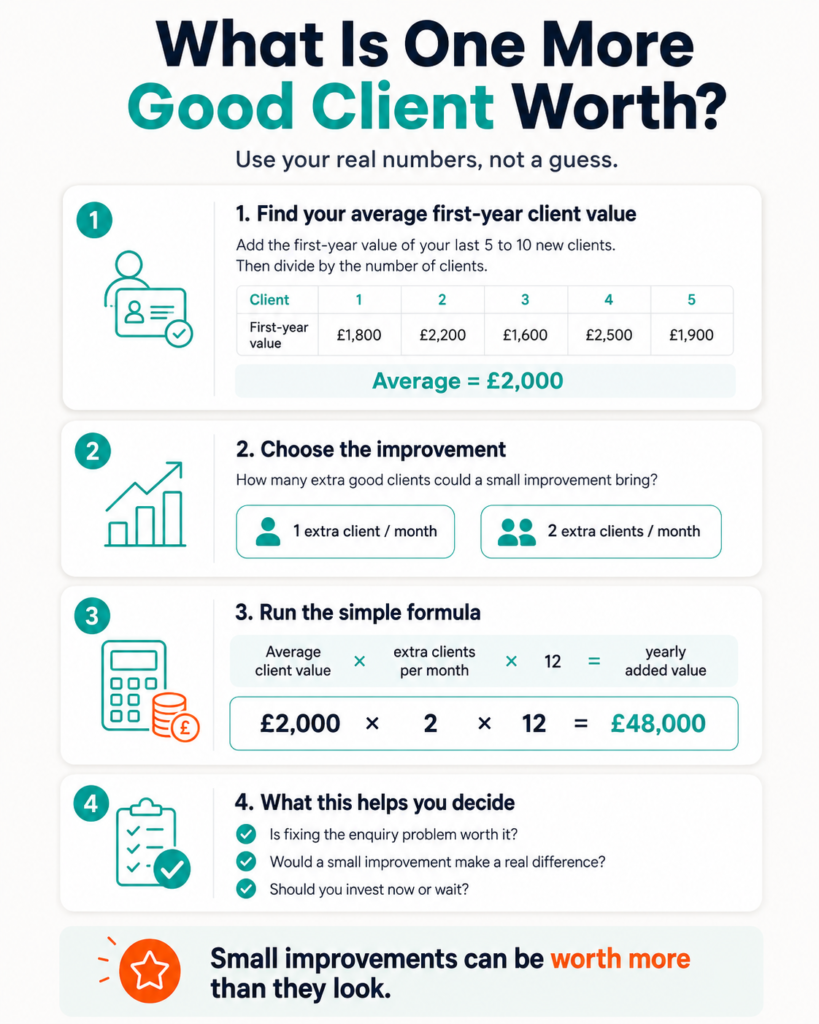
Pull up your last five to ten new clients. Use real clients, recently onboarded, not the exceptional case you still talk about years later.
For each client, note the total fees or revenue they generated in their first year.
Then add those figures together and divide by the number of clients.
The formula is:
Total first-year revenue from recent new clients ÷ number of clients = average first-year client value
For example:
| Client | First-year value |
|---|---|
| Client 1 | £1,800 |
| Client 2 | £2,200 |
| Client 3 | £1,600 |
| Client 4 | £2,500 |
| Client 5 | £1,900 |
Total first-year value: £10,000
Number of clients: 5
Average first-year client value: £2,000
That gives you a practical baseline. It is not perfect, but it is far better than guessing.
Why You Should Use Real Clients, Not Memory
Memory is a terrible calculator.
You remember the unusually large client. You remember the painful one. You remember the one that came back again and again.
The average client is easier to forget because they are normal. But normal is exactly what you need for this calculation.
If you build the number around your biggest client ever, everything looks more exciting than it should. That can lead you to invest based on a best-case scenario rather than a realistic one.
Use recent clients. Use real numbers. Let the average do its job.
Revenue and Profit Are Not the Same Thing
Revenue tells you how much money came in. Profit tells you how much was left after the cost of delivering the work.
Both are useful, but they answer different questions.
Revenue gives you a quick sense of scale. It helps you see what one or two extra clients might mean at the top line.
Profit is more useful when you are deciding whether to invest. A client worth £5,000 in revenue is not worth £5,000 to the business once time, team costs, overheads and delivery are included.
For a quick exercise, start with revenue. Then repeat the calculation using gross profit if you have the figures.
That second number is usually the more honest one for decision-making.
A Simple Manual Calculator
You do not need a fancy tool to start. Use this simple table.
| Step | What to work out | Example |
| 1 | Average first-year client value | £2,000 |
| 2 | Average gross profit per client | £1,200 |
| 3 | Extra good clients per month | 2 |
| 4 | Monthly added value | £4,000 revenue or £2,400 gross profit |
| 5 | Yearly added value | £48,000 revenue or £28,800 gross profit |
The simple formula is:
Average client value × extra clients per month × 12 = yearly added value
Using the example above:
£2,000 × 2 × 12 = £48,000
That does not mean you are guaranteed to make £48,000. It simply shows what the opportunity could be worth if the improvement is real.
Why Small Improvements Can Be Worth More Than They Look
A lot of firms assume they need a huge increase in traffic or enquiries for marketing to be worth fixing. That is not always true.
Sometimes the commercial upside sits in a small improvement.
One more good client a month may not sound dramatic. But if a good client is worth £3,000 in first-year value, that is £36,000 a year.
Two more genuine enquiries converting per quarter may sound modest. But if each client is worth £5,000, that is £40,000 a year.
Recovering one missed enquiry a month can matter too. If those enquiries were already coming in but not being followed up properly, the improvement may come from fixing leakage rather than buying more traffic.
That is the point of this calculation.
You are not trying to make the number look impressive. You are trying to see whether the opportunity is worth taking seriously.
What This Means for Website Enquiries
Once you know what a new client is worth, you can look at your website differently.
You stop asking only, “How many visitors did we get?”
You start asking better questions.
- How many genuine enquiries came in?
- How many were a good fit?
- How many became calls, meetings or clients?
- Where did the others drop off?
- How much would it be worth if one or two more of those opportunities converted?
Those are much better questions than staring at traffic numbers and hoping they mean something.
If your website already gets visitors but too few become enquiries, the problem may not be traffic. It may be the message, the decision path, the form, the follow-up or the way enquiries are handled after they arrive.
If enquiries are already arriving but not becoming clients, the next step is to look at what happened to them.
Once you know what a good client is worth, read What Happened to Your Last 10 Genuine Enquiries?. It shows you how to trace recent enquiries from arrival to outcome.
The Big Headline Number Trap
There is nothing wrong with ambition. But using your biggest client ever as the benchmark will usually make the maths misleading.
That client is the exception. Your decision should be based on what is typical.
This is especially important when deciding whether to invest in fixing your website or enquiry process. If the numbers are inflated, the decision may look safer than it really is.
A rough number based on real clients is more useful than a precise-looking number based on hope.
That is the rule to remember.
What This Number Is Actually For
This number is not there to make you feel good. It is there to help you make better decisions.
Once you know your average client value, you can weigh it against the cost of fixing whatever is holding enquiries back.
If your average client value is low, the improvement needs to be meaningful enough to justify the effort. You may need more volume, a lower-cost fix or a clearer way to improve conversion.
If your average client value is high, even a modest improvement can justify proper investment. One or two extra good clients may change the entire calculation.
The number also helps you avoid chasing the wrong thing.
If your website gets plenty of visitors but hardly any genuine enquiries, more traffic may not be the first fix. If you get genuine enquiries but they go cold, follow-up may be the issue.
The value of a new client helps you decide how much the problem is worth solving.
When This Calculation Is Not Enough
This calculation is useful, but it is not the whole picture.
It does not tell you where the enquiry problem sits. It does not tell you whether your website, traffic, message or follow-up needs fixing first.
It also does not tell you whether the next client will match the average. Real businesses are messier than that.
Use this number as a starting point, not a guarantee.
First, work out what a good client is worth. Then look at where enquiries are being won, lost or missed.
That is how you make a better decision.
The Bottom Line
You cannot judge whether fixing your enquiry problem is worth it until you know what a new client is actually worth to your business.
You do not need a complicated model to start. Take your last five to ten new clients, add their first-year value and divide by the number of clients.
That gives you a real baseline.
Once you know that number, the decision becomes clearer. You can see whether one more good client a month, two more a quarter or a better follow-up process is worth chasing.
Not sure whether fixing your website enquiries is commercially worth it?
Book a More Clients Call. We’ll help you look at your current enquiry numbers, what a good client is worth, and whether there is enough upside to justify fixing the problem properly.