You ran the numbers and got a figure that looks exciting. Before you treat it as a promise, it is worth slowing down for a minute.
A calculator result can show what might be worth investigating. It does not tell you what will definitely happen.
That difference matters because calculator numbers can look more certain than they really are. If you treat an estimate like a guarantee, you will almost always end up disappointed.
Not because the calculation was useless. Because it was never meant to predict the future in the first place.
Here is what your ROI calculator result actually means, what assumptions sit behind it, and how to use the number properly.
Key Takeaways
- A calculator result is a decision tool, not a forecast
- The number is only as useful as the inputs behind it
- A big number does not mean the result is guaranteed
- The assumptions matter more than the headline figure
- The real job is to decide whether the opportunity is worth checking properly
What Does My ROI Calculator Result Actually Mean?
Your ROI calculator result is an estimate based on the numbers you put in. It usually takes things like your average client value, current enquiry numbers, conversion rate or expected improvement, then turns them into a possible opportunity.
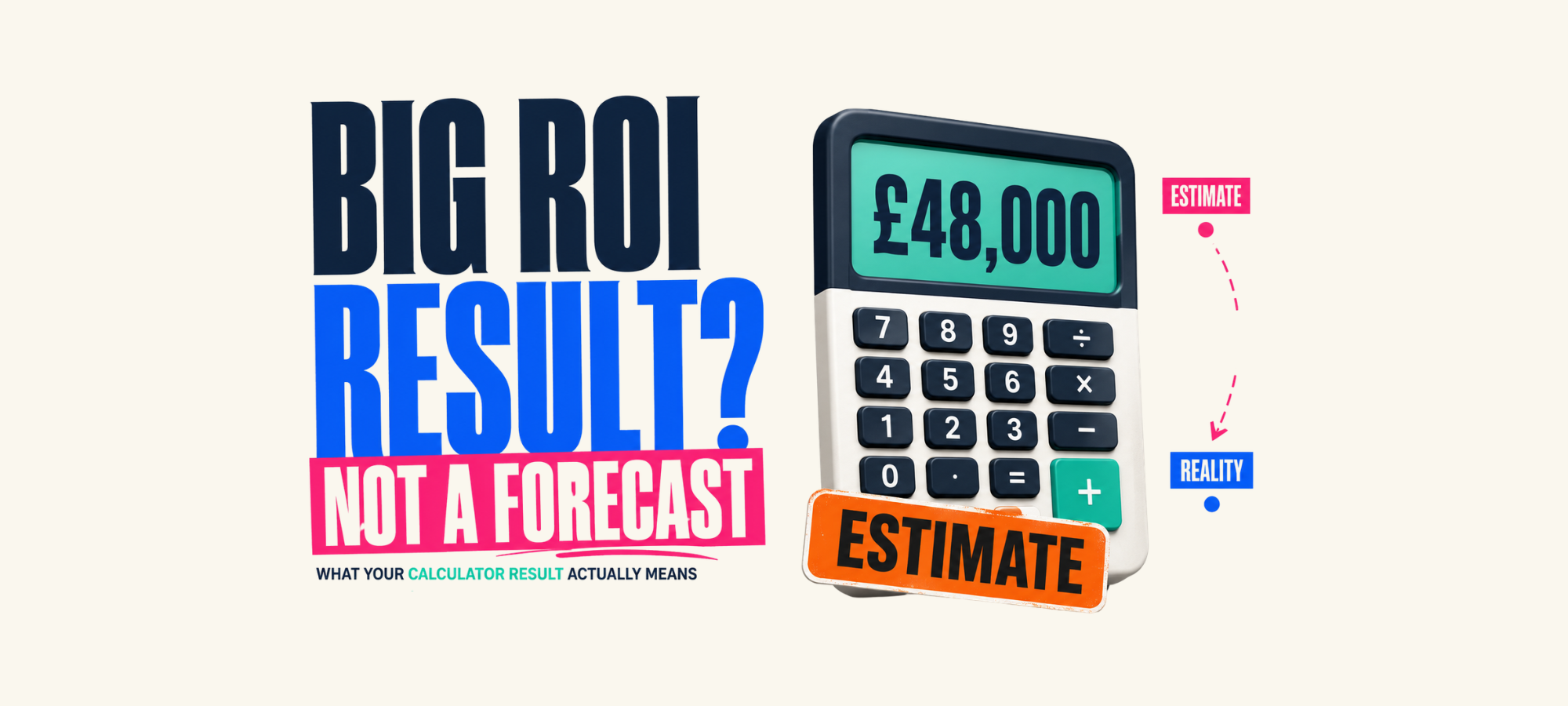
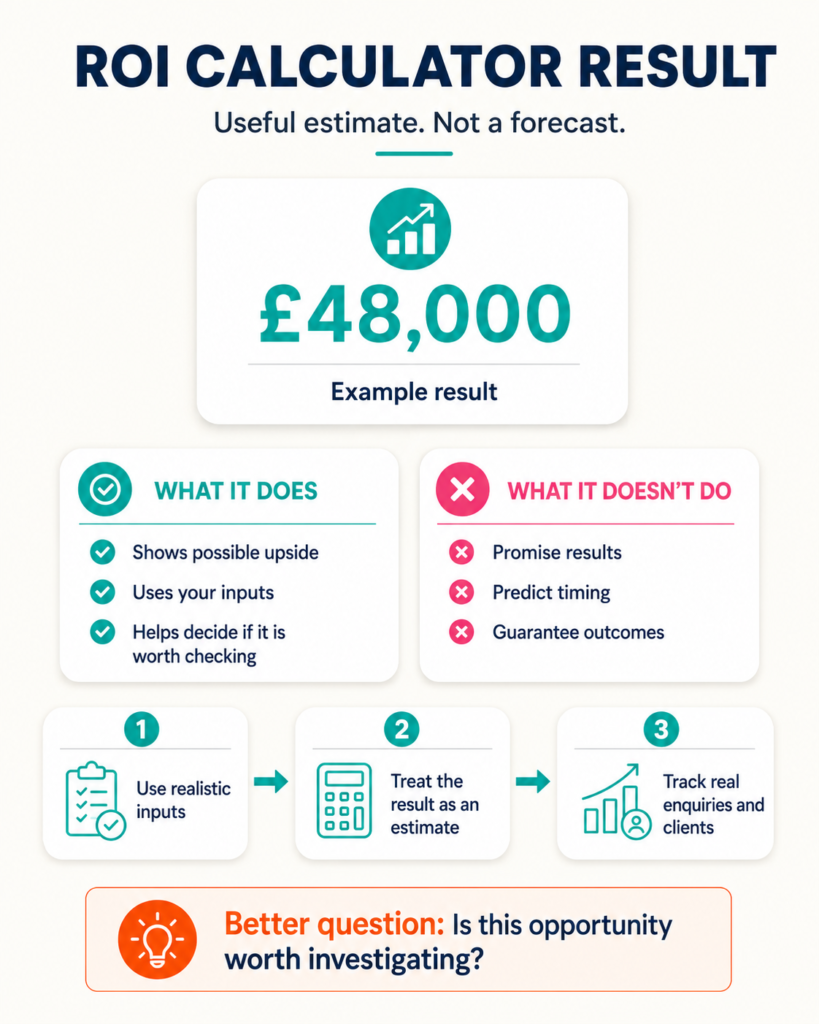
The maths itself may be straightforward. For example, if your average client value is £2,000 and you estimate two extra good clients per month, the calculation gives you £48,000 a year.
That does not mean £48,000 is guaranteed. It means the opportunity could be worth looking at if the inputs are realistic and the improvement is achievable.
That is the key distinction. A calculator gives you a commercial estimate, not a promise.
Why the Number Can Look So Big
Small improvements can create surprisingly large numbers when you multiply them across a year. One extra good client per month may sound modest, but if a good client is worth £3,000, that is £36,000 a year in possible added value.
Two extra good clients per month at £5,000 each becomes £120,000 a year. That does not make the calculation wrong. It simply means the size of the opportunity depends heavily on your average client value and the improvement you are testing.
This is why calculator results can feel exciting. They take a small monthly change and show what it might mean over time.
That can be useful when you understand the assumptions behind the number. It can also be misleading if you treat the number as something that is definitely going to happen.
The Assumptions Behind the Number
Every calculator result has assumptions baked into it. Those assumptions are not a problem, as long as you know they are there.
They may include:
- your average client value
- your profit margin
- your current enquiry volume
- your current conversion rate
- the number of extra enquiries you could generate
- the number of extra clients you might win
- the time period used in the calculation
- whether repeat work is included
- whether the figures are based on revenue or profit
None of those inputs are magic. If the average client value is too high, the final number will be too high.
If the expected improvement is too optimistic, the result will look better than it should. If the calculation uses revenue but you think of it as profit, the number will feel more valuable than it really is.
That is why the inputs matter more than the final figure. The output can only be as honest as the numbers behind it.
Why It Is Not a Forecast
A forecast tries to predict what will happen. A calculator result does not do that.
It shows what could happen if certain assumptions were true. That is useful, but it is not the same as a future result you can bank on.
A calculator does not know whether your market will get quieter next month. It does not know whether your team will follow up faster, whether your offer is clear enough, or whether your website is currently losing people before they enquire.
It also does not know how quickly a fix will take effect. Some improvements show quickly, while others need more time before the pattern becomes clear.
The calculator is not failing when reality behaves like reality. It is only doing the first job, which is helping you decide whether the opportunity is worth a closer look.
Where Firms Misread Calculator Results
The biggest mistake is treating the number like a target. Someone runs the calculation, sees £48,000, and the number quietly becomes an expectation.
The conversation changes from “this might be worth investigating” to “this should bring in £48,000”. That is where the problem starts.
Three months later, if the actual result falls short, the whole exercise can feel disappointing. Even if things improved, they may feel like they failed because they did not match the calculator number.
That is not a fair way to judge it. The calculator number was created before the work started, so your actual results should be judged against your real starting point.
The Precision Trap
A projected figure can look more reliable than it really is. £48,217.63 feels more official than “around £48,000”.
The extra decimals do not make the estimate more accurate. They just make it look more precise.
This matters because precise-looking numbers can make people overtrust the result. The calculator may be using estimates, but the output looks like something from an accountant’s spreadsheet.
For most business decisions, a rounded number is more honest. It is better to say “this could be worth roughly £40,000 to £50,000 a year if the assumptions hold” than to pretend the exact number is certain.
A rough, honest range is usually more useful than a precise-looking guess. It keeps the number helpful without making it look like a promise.
What the Number Is Actually For
The number is there to help you answer one question. Is this worth investigating properly?
That is the job of a good calculator result. It helps you decide whether the possible upside is big enough to deserve more attention.
If the possible upside is tiny, you may decide the problem is not worth spending much time or money on. You might still fix it, but it may not be the next commercial priority.
If the possible upside is meaningful, it may justify a proper review of your website, enquiry process or follow-up. That does not mean you should rush into a rebuild, ads, SEO or a new supplier.
It means the opportunity may be worth diagnosing. The number helps you decide whether the problem deserves attention before you start guessing at the fix.
How to Use the Result Properly
Use the calculator result as a threshold, not a promise. It should help you decide whether to look deeper, not become the number you expect to see in your bank account.
Start by asking:
- Are the inputs realistic?
- Did I use average clients, not outliers?
- Did I use revenue or profit?
- Is the improvement modest or optimistic?
- Would this opportunity be worth exploring if the number were only half right?
- What would need to be true for this result to happen?
That last question is the most useful one. For the calculator number to become real, something in the business has to change.
More of the right people may need to find the website. More visitors may need to enquire, more enquiries may need to become calls, or more calls may need to become clients.
The calculator result helps you see the possible value. The next job is to find which part of the journey needs attention.
What to Track After You Act
Once you decide to act, stop judging everything against the calculator number. Start tracking reality.
That means looking at:
- genuine enquiries
- enquiry sources
- enquiry quality
- booked calls
- new clients
- first-year client value
- follow-up speed
- conversion from enquiry to client
Compare those numbers to where you started. That will tell you more than comparing everything to the original estimate.
If enquiries improve, that is useful. If enquiries stay flat but quality improves, that is useful too.
If traffic increases but enquiries do not, that tells you something else needs attention. The real value comes from learning what is actually happening in your business.
The calculator simply gave you a reason to look. The tracking tells you what is really changing.
What if the Real Result Is Lower Than the Calculator?
If the real result is lower than the calculator, it does not automatically mean the calculator was pointless. It may simply mean the assumptions were too optimistic.
It may also mean the active problem sat somewhere different from where you expected. For example, you may have assumed the issue was traffic, but the real gap was follow-up.
Sometimes the improvement needs more time. Other times, the website, message, decision path or enquiry handling needs deeper work before the full opportunity can show up.
That information is useful. A gap between the estimate and the result is not failure by itself.
It is feedback. The important thing is to use real numbers to improve the next decision, rather than throwing out the whole idea because the first estimate did not land perfectly.
How This Connects to Client Value
Before you can interpret any ROI calculator result, you need a sensible client value number. If your average client value is a guess, the calculator result will be a guess too.
That is why it is worth calculating your first-year client value before relying on any bigger ROI number. A realistic client value makes the calculator much more useful.
If you have not done that yet, start with What Could One More Good Client Be Worth to Your Business?. It shows you how to work out the number using your own recent clients.
Once that number is realistic, any calculator result becomes more useful. It will still be an estimate, but it will be based on better inputs.
The Bottom Line
A big ROI calculator result can be useful. It can show that a small improvement may be worth taking seriously.
But it is not a forecast. It is an estimate based on your inputs, your assumptions and a possible improvement.
Treat it as a decision tool, not a promise. Use the number to decide whether the opportunity is worth investigating.
Then judge the real outcome against what actually happens once you act.
Not sure whether the number is worth taking seriously?
Book a More Clients Call. We’ll help you look at your enquiry numbers, client value and current website setup, so you can see whether there is enough upside to justify fixing the problem properly.