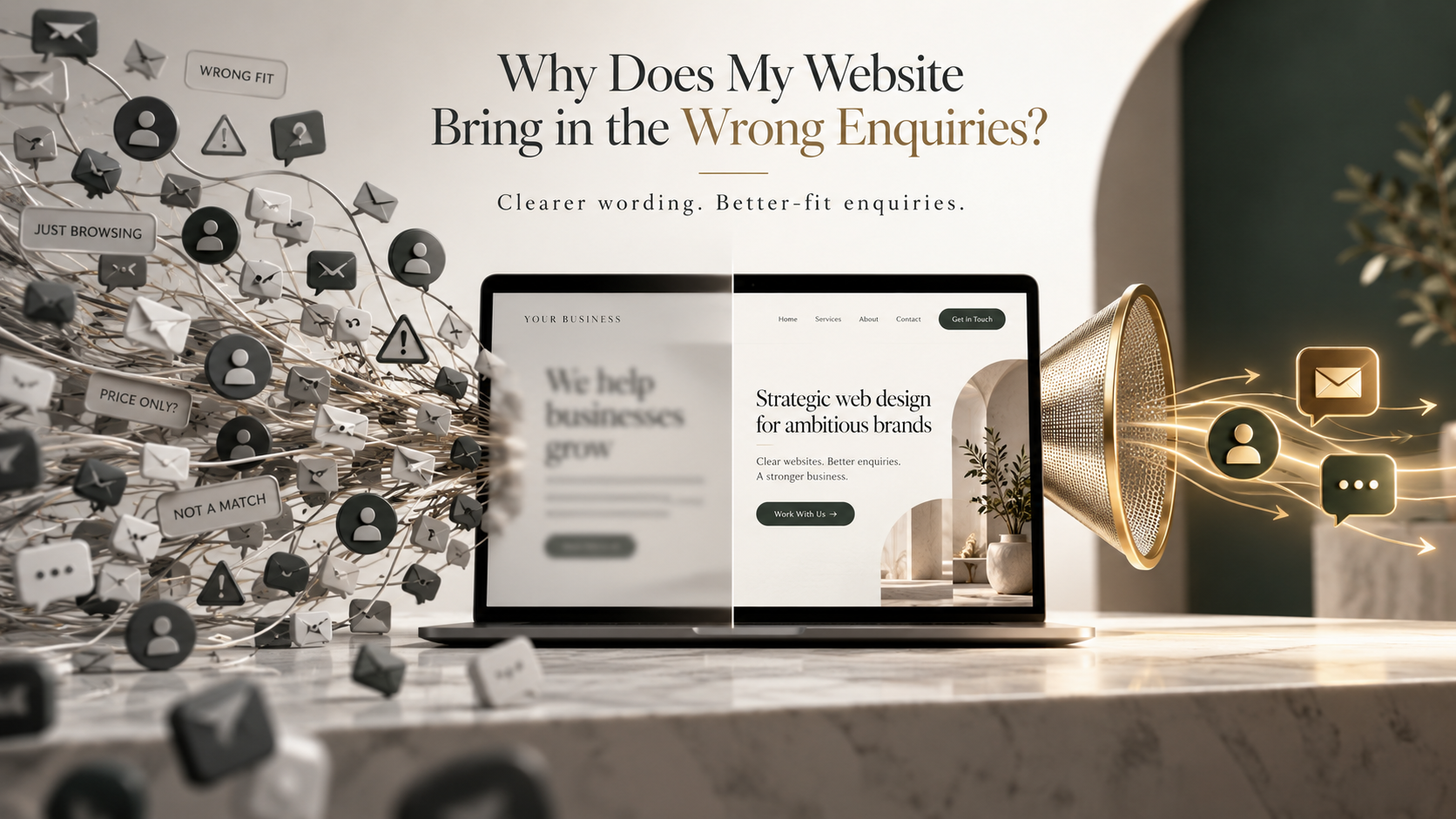
Your website usually brings in the wrong enquiries because the words on it are broad enough to fit almost anyone. If a page could describe ten other firms, it will attract the people those ten firms would turn away too. The fix is rarely more traffic or a new form. It is clearer wording about who you are for, and who you are not for.
Do you spend hours on calls and quotes for work that was never going to be yours? And when you push for more enquiries, do you mostly get more of the same?
That is a real cost. It does not show up on any invoice, but it eats the time you meant to spend on the clients you actually want.
By the end of this article, you’ll know where vague wording tends to hide on a website and what it costs you. You’ll also know what to change first. Then we’ll look at what to check if the wording turns out not to be the problem.
Key takeaways
- Wrong enquiries usually start with wording that tries to appeal to everyone.
- Specific words help the wrong people rule themselves out before they get in touch.
- Your homepage headline, service pages and contact page are the first places to check.
- Being clearer may bring fewer enquiries overall, but more of the kind you can say yes to.
- If the wording is clear and the wrong people still arrive, look at where they come from and what happens after they enquire.
In this article
- What counts as a wrong enquiry?
- Why does vague wording attract the wrong people?
- Where is the wording too vague on your website?
- Won’t being specific mean fewer enquiries?
- What should you change first?
- What if the wording isn’t the problem?
- What does this look like in practice?
- FAQs
What counts as a wrong enquiry?
A wrong enquiry is anyone who gets in touch for something you can’t or won’t do well. That might be a service you don’t offer. It might be a job far smaller than you take on, or a budget that was never going to work.
Sometimes it’s someone outside the area you cover. Sometimes it’s a person collecting five quotes to pick the cheapest.
None of these people are doing anything wrong. They read your website and thought you might be the answer. That’s the bit worth sitting with.
The cost adds up in small pieces: a call, a proposal, a follow-up email to someone who then goes quiet. If you’ve ever looked back over a month and wondered where the time went, a good place to start is your last ten enquiries. Tracing each one shows you how many were ever a real fit.
Why does vague wording attract the wrong people?
Broad words let every reader fill in their own meaning. “We offer a wide range of services” tells a visitor almost nothing. So they assume you do the thing they need.
Phrases like “client-focused”, “tailored advice” and “for businesses of all sizes” work the same way. They sound safe. But they give the wrong person no reason to stop and think “this isn’t for me”.
Specific words do the opposite. When a page says who you help and what you don’t take on, the wrong people often rule themselves out. They never fill in the form. You never have the call.
In my experience, this is where a lot of firms get stuck. Being broad feels like keeping your options open. In practice, it hands the sorting job to you, one enquiry at a time.
Where is the wording too vague on your website?
You don’t need to rewrite everything to find the problem. Start with the pages people read before they get in touch.
Your homepage headline
Read it as a stranger would. Could a competitor put their logo on it without changing a word? If so, it isn’t helping anyone decide whether you’re the right fit.
Your service pages
Look for lists of services with no detail about who each one is for. A page that names a service but never describes the client, the situation or the typical size of job leaves the reader guessing.
Your about page
Many about pages talk about values and history. That’s fine, but check it also says the kind of clients you work with best.
Your contact page and form
If the form asks for a name, email and “how can we help?”, every enquiry arrives looking the same. One extra question, such as what the enquiry is about, can help you spot fit early.
Your Google Business Profile
The description there is often written once and forgotten. If it’s vaguer than your website, it may be sending you people your website would have put off.
A useful test is to ask a long-standing client to describe what you do in one sentence. If their answer is sharper than your homepage, that’s your new starting point.
Won’t being specific mean fewer enquiries?
It might. That’s the honest answer, and it’s the worry that stops a lot of firms from changing anything.
But count what you’re actually losing. If a chunk of your current enquiries were never going to become clients, losing them costs you nothing. It gives you back the hours you were spending on them. Those hours are better spent on the people who could be worth a lot more to you.
What you want is more of the enquiries you can say yes to. Fewer enquiries with a higher share of good ones is usually a better week than a full inbox of the wrong ones.
If you’ve been burned by marketing before, this can feel uncomfortable. You’ve probably been told that more is always better. Then you were left to work out why none of it turned into work.
Clearer wording won’t fix everything. But it’s one of the few changes you can see and check for yourself. You can read the old words and the new ones side by side and decide which sounds like your firm.
What should you change first?
Start small and start with evidence from your own inbox.
- Write down your last ten wrong-fit enquiries. Note what each person asked for and where they found you, if you know.
- Find the line that invited them. Go to the page they most likely read. Look for the sentence that made them think you were a fit.
- Say who you are for. Rewrite your homepage headline and the opening of your main service pages. Name the type of client and the kind of problem you help with.
- Say what you don’t do. A short line such as “We don’t take on [type of work]” can save you a lot of calls. It can also come across as confident.
- Help people check fit near the button. A sentence above your contact button about who it’s for helps the right people feel sure and the wrong people pause.
- Add one question to your form. Ask what the enquiry is about, or which service they need. It won’t stop every wrong enquiry, but it helps you sort them quickly.
Some firms also find it helps to give a rough idea of cost, such as a typical starting point. Whether that suits you depends on how standard your work is. What matters is that you decide on purpose, rather than leaving prices off by default.
Once you’ve made changes, give them time and keep counting. Compare the next ten enquiries with the last ten. In my experience, that comparison tells you more than most reports.
What if the wording isn’t the problem?
Sometimes the words are clear and the wrong people still turn up. When that happens, look at where they come from.
Paid ads with broad search terms can send people who never read your service pages properly. Directory listings and old profiles can describe you in ways you’d never choose. A referral partner might be describing you loosely too.
It’s also worth checking what happens after someone gets in touch. A good-fit enquiry that waits two days for a reply can go cold and look like a bad one. That’s a follow-up problem, not a wording problem.
This is why it pays to find out where the problem sits before you change anything. Rewriting a homepage won’t help if the real issue is a search term in your ads. More traffic won’t help if the message is still inviting everyone.
What does this look like in practice?
A small London law firm that handles business disputes came to us wanting more of that work. They also wanted better enquiries than a paid leads platform was giving them.
Over about four months, we revamped their website and rewrote most of their articles and service pages. We added new pages for the disputes they wanted more of. SEO and their Google Business Profile work ran alongside.
We compared January to April 2026 with May to August 2026. Website enquiries went from 18 to 23. Enquiries about business matters through the website forms went from 10 to 19, up 90%.
So the total rose a little, while enquiries about business matters nearly doubled. These are early results and small numbers. We sorted the enquiry types ourselves from the form messages, and we don’t know how many became clients. The work all ran together, so no single change gets the credit.
Find out where your enquiries are going wrong
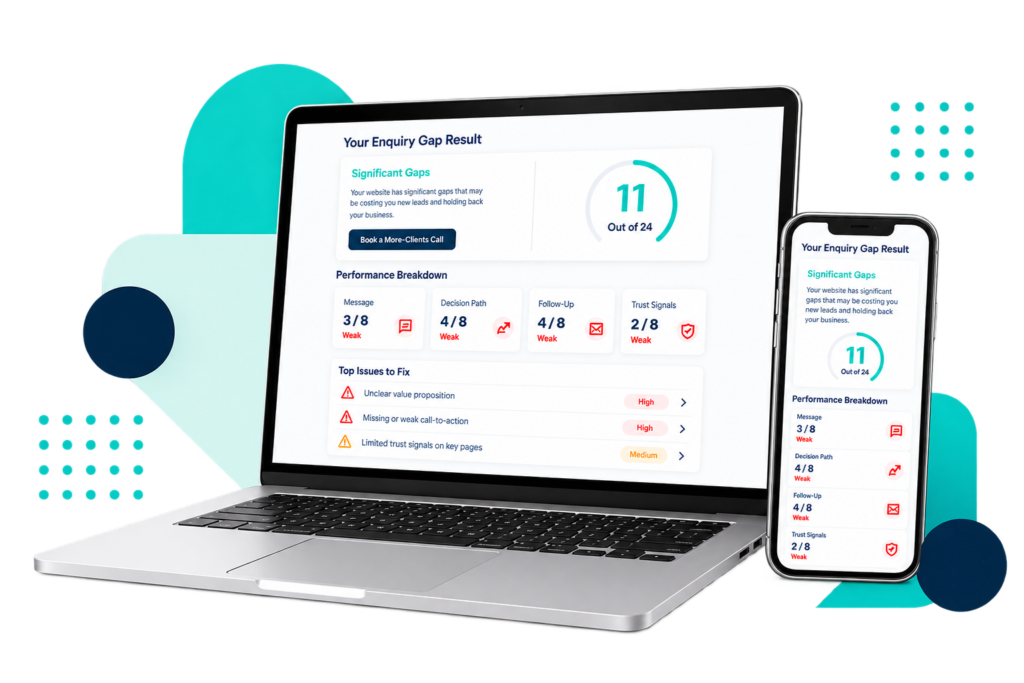
If you’re not sure whether your wording, your next step or your follow-up is the weak point, the Enquiry Gap Assessment can help. It’s a two-minute check that scores your Message, Decision Path and Follow-Up, and shows you which to fix first.
Take the Enquiry Gap Assessment
FAQs
Is it normal to get some wrong enquiries?
Yes. Every firm gets a few, and no website will filter out every one. If they make up a big share of your enquiries week after week, though, your wording is worth a closer look.
Will being more specific reduce my enquiries?
It might reduce the total. The aim is a higher share of enquiries you can say yes to. Losing enquiries that were never going to become clients gives you time back.
How do I know if my website wording is too vague?
Try the logo test. If a competitor could put their logo on your homepage without changing a word, it’s too vague. You can also ask a good client to describe what you do and compare it with your site.
Should I put prices on my website?
It depends on how standard your work is. A typical starting point can help people rule themselves in or out. Either way, it’s worth deciding on purpose rather than by default.
Can a better contact form stop the wrong enquiries?
A good form helps you sort enquiries faster, but it filters at the door. Clear wording further up the page stops many wrong-fit enquiries before they start. The two work best together.
Could my ads or directory listings be causing it?
They can. Broad search terms in ads and loose descriptions on directories can send people who expect something you don’t offer. Check where your wrong-fit enquiries came from before you rewrite anything.
What does the Enquiry Gap Assessment check?
It scores three areas: your Message, your Decision Path and your Follow-Up. It takes about two minutes. At the end you see which area is most worth fixing first, so you’re not guessing.
Better-fit enquiries start with clearer words
Wrong enquiries rarely mean people are careless. Usually they read words that could have meant anything and filled in the gaps themselves.
Clearer wording gives the right people a reason to get in touch and the wrong people a reason to look elsewhere. In my experience, it’s one of the cheaper changes you can make, and you can check the result in your own inbox.
The longer vague wording stays up, the more hours go on quotes that were never yours. If you want to know whether wording is your weak point, or something else is, start with the assessment.